The Most Deceptive Graph Ever Made?

A Famous Graph of the Triumph of Science Actually Shows Just What is Wrong with Our Agriculture

It’s the most reproduced chart in anything ever written on agriculture. It shows a triumph of science: the meteoric rise in US corn yields following the adoption of hybrid corn.

Brief explanation: “hybrid” is used loosely to refer to any mixture of differences, but it has special meaning for corn (and some other crops). Corn plants produce pollen that floats on the wind to pollinate other corn plants; they almost never pollinate themselves and when they do, their offspring tend to be sickly from “inbreeding depression.” This was the last thing corn breeders wanted.

At least until around 1900, when scientists rediscoved Mendel, whose research on heredity — now known to every high schooler — somehow flew under the radar his 1860s contemporaries. By the 1910s “Mendelian” crop breeders in the US were adopting the new strategy of inbreeding corn, creating separate fields of sickly but pure-bred strains. Then when they crossed these inbreds, sometimes the offspring had “hybrid vigor” and higher yield.
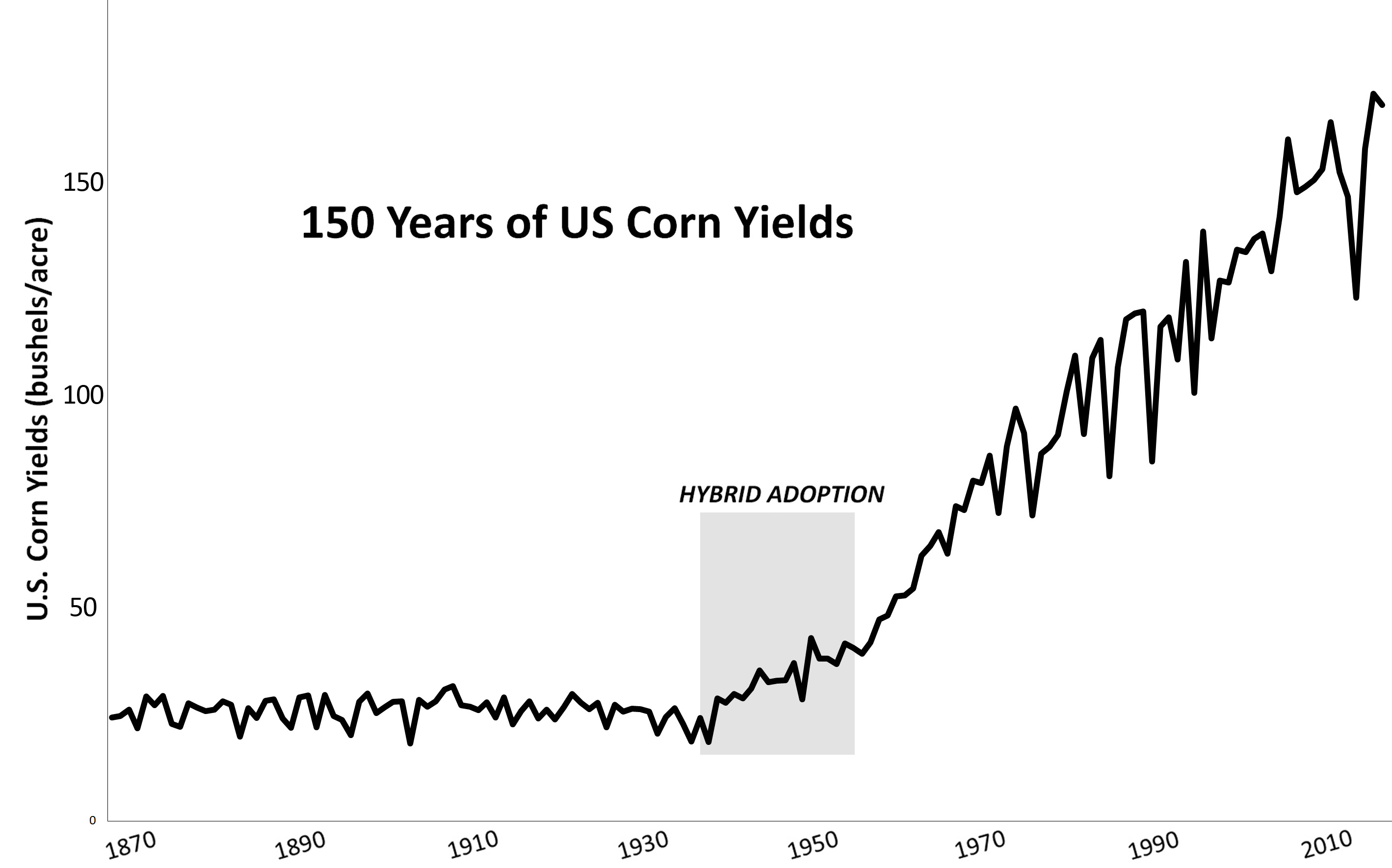
Corn Yields
Here it is, folks. Data are from the USDA. The grey box indicates that period of hybrid adoption, when plantings of hybrid (as opposed to conventional, or “open-pollinated”) seeds rose from 1% to 95%.

A few commercial hybrid corn brands appeared in the 1920s, then more in the 1930s and 40s. Farmers were skeptical at first, but during the 1940s, hybrids spread; as one agriculturalist put it, their “dramatic improvement in yield potential must have truly seemed like a miracle.” Corn yields, which had barely budged in the previous 50 years, shot from 19 to 43 bushels between 1934 and 1948.

Highlights of the millenium: Einstein’s relativity, Hitler, and hybrid corn. Source: N. Holmes 1992 1,000 years at a glance. Time 140(27).

This breakthrough has been praised in almost religious terms ever since. “Little did Malthus know,” said a US government publication, that “hybrid corn would delay for almost two centuries the impact of his dire predictions” that food production could never keep up with population. Hybrid corn has even been hailed as one of the greatest achievements of the millennium, compared in importance to nuclear power, and credited with checking the spread of Communism [1].

Little wonder that that chart has been reproduced many times over [2].

But another reason for chart’s popularity is that it’s actually about much more than corn and hybrid vigor. It reflects and reinforces the important belief that agricultural science is there to keep us from starving — or eating each other like in Soylent Green. As Norman Borlaug, the “father of the Green Revolution”, put it in his 1970 Nobel prize acceptance speech, “we are dealing with two opposing forces, the scientific power of food production and the biologic power of human reproduction”. The claim that hybrid corn saved lives helps to validate the subsequent waves of technology.
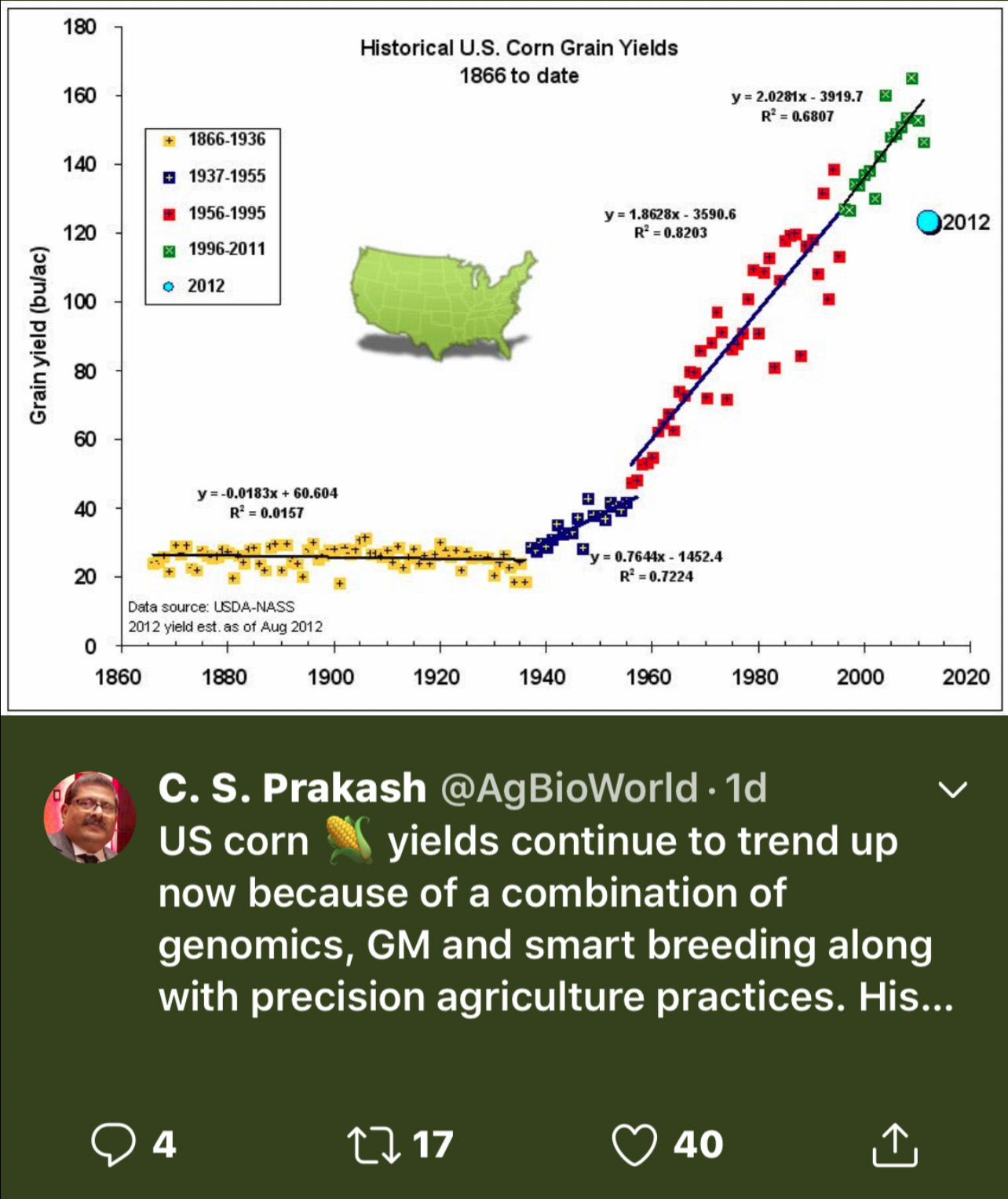
Tweet from biotechnologist. It even includes slopes, intercepts, and r2 values to show how scientifical the chart is. But to actually be scientific it should show trends in other crops, which we do below.

Here, for instance, is professional biotechnology booster CS Prakash posting his version of the corn graph to endorse genetically modified crop technologies.

And it is true that corn yields have been tending upwards ever since the late 1930s. But everything else that has been inferred from the chart is wrong. The chart is actually a textbook of everything that is wrong with American agriculture.

All crops were rising

First, attributing rising corn yields to hybrids is sleight of hand. If someone told you they had a teenage growth spurt because they ate their Wheaties, you would probably point to the counterfactual, to use the technical term: the non-Wheatie-eating teenagers grew just as much! By the same token, when they tell you corn yields took off because of hybrid technology, shouldn’t you ask if non-hybrid crops took off just as much?

Turns out non-hybrid crops took off more.

This figure shows the history of yields for the US’s top 5 crops. The pattern in unmistakable: all of these crops took off in the 1940s, and none were hybrids except corn. In fact, corn yields were growing more slowly than most non-hybrid crops.
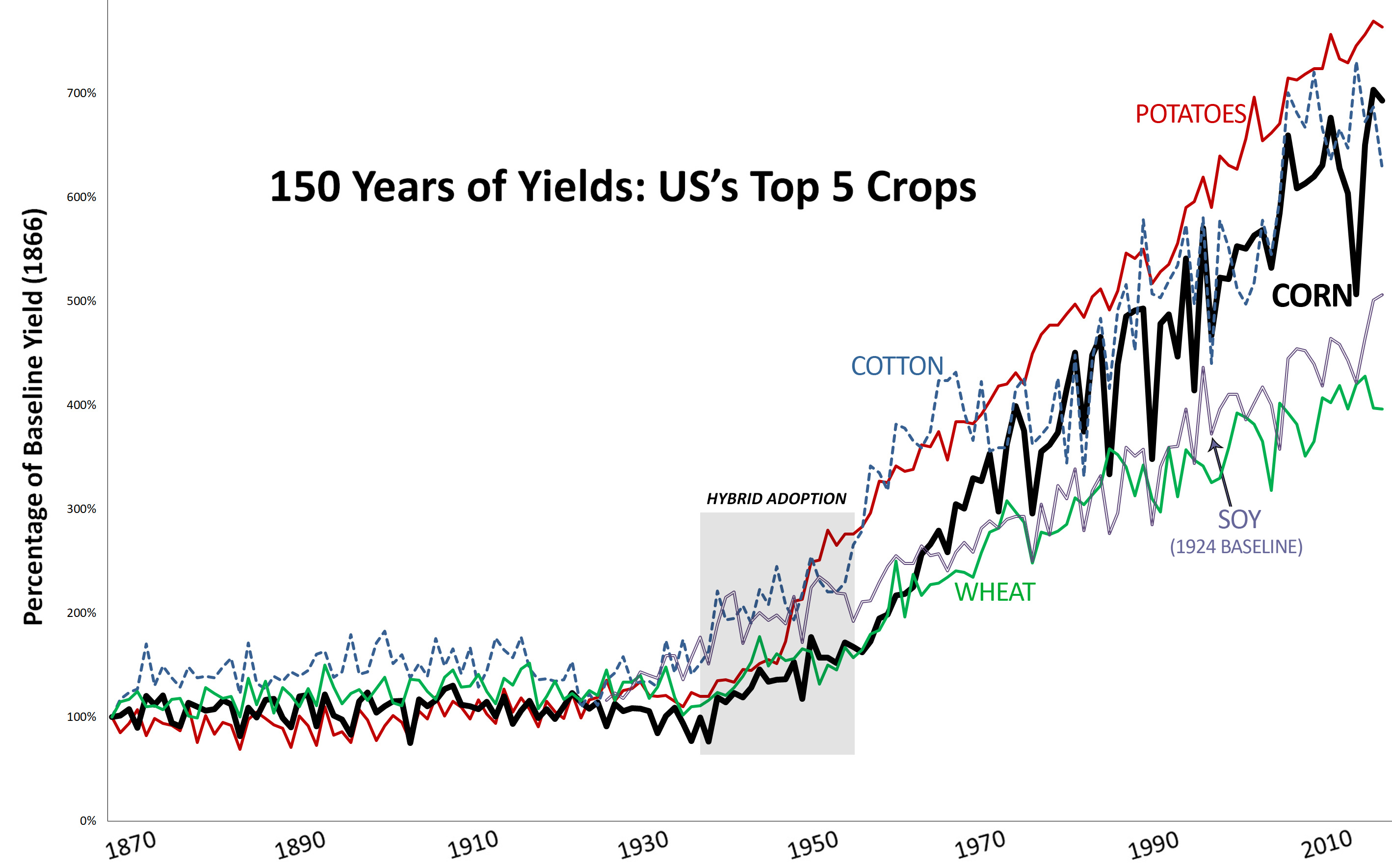
The rise of corn yields compared to other major crops...none of which were hybrids.

The reasons for the upturns are no secret. While hybrid corn was spreading, fertilizer use more than doubled, pesticide spread, and mechanization rose — including a fourfold increase in mechanical harvesters and tractors between 1935 and 1955. [3, 4] In terms of productivity, hybrid corn was no breakthrough at all.

But what a breakthrough for seed corporations, for whom “hybrid vigor” would allow them to get their snouts deeper into the government trough than they ever had before.

Hybrid Vigor and Corporate Welfare

The concept of hybrid vigor is widely misunderstood. Saying that offspring of crosses of pure line varieties exhibit hybrid vigor is like saying that playing roulette makes you rich; the vast majority of offspring from inbred crosses show no hybrid vigor and are not even productive at all. This was known from the beginning of Mendelian breeding; in fact Erich von Tschermak – one of the scientists who “rediscovered” Mendel – stressed as early as 1901 that breeders would have to plant huge numbers of hybrids to find the rare offspring with superior performance. “Given only 100 inbred lines,” asks Jack Kloppenburg, “there are 11,765,675 possible double-cross combinations…[h]ow could all those crosses be made?” [1].

Moreover to be of economic value, the offspring had to not only outperform farmers’ corn, but beat it enough to warrant the expense of buying seeds. That’s because “hybrid vigor” only lasted for one season, and if seeds from the hybrid crop were saved for replanting, yields would plummet.

In other words, it was hardly an agricultural breakthrough; hybrid corn was an uneconomic, needle-in-a-haystack strategy that would require a vast amount of land, time, and work by breeders.

But it was a breakthrough for the Mendelian breeders in public institutions (like the USDA, land-grant universities, and agricultural experiment stations), because it allowed them to publish more scientific research articles and raise their status in the competitive world of science. In 1913 the American Breeders Association refashioned itself as the American Genetic Association and replaced its American Breeder’s Magazine with the more scientific Journal of Heredity as its official publication; its other publication, the Proceedings, doubled the amount published during the teens.

But hybrid breeding was an even bigger breakthrough for seed companies, which managed to convince the public breeding sector to do most of the hundreds of thousands of test plots and then turn over the haystack needles to the companies to sell for profit. Congress sent a gusher of money to help finance the work; the 1925 Purnell Act allocated up to $60,000/year (= about $1.1 million today) to each state agricultural experiment station, mainly to breed hybrids.

Mid-century ad by Pioneer Hybrid Seed Company, stressing the research needed to find the rare offspring that might be marketable. But Pioneer was launched with plants from public breeding and in reality the man in the white shirt usually would have been a publicly funded breeder, essentially working for seed companies instead of the farmers.

Of course it is not surprising that tax payers’ money would support basic scientific research that eventually leads to commercial products; that’s how things should work most of the time. But by the 1940s, the hybrid corn takeover led to the shriveling and then disappearance of the conventional “selectionist” breeding that had been developing and providing free improved seeds to farmers across the country. That corn yields had not been rising was not seen as a problem; in fact throughout the 1920s as Mendelian breeders were taking over the public breeding sector, the country was suffering from overproduction.

Overproduction: Gas on the Fire

The enormous irony of the famous chart of scientific triumph is that the surge in yields was the last thing the country needed. Agricultural — especially grain — overproduction had been a gathering problem through the late 1920s, and prices were crashing. Congressman Miles Allgood said that the overproduction problem was bad enough that research was needed to develop crop diseases!

And the proposal was not entirely tongue-in-cheek; as the former Alabama Commissioner of Agriculture, he had seen suppression of the boll weevil cause overproduction to the point of disastrous oversupply and realized that the boll weevil had been the “best friend the cotton farmer ever had”.   The citizens of Enterprise AL famously erected a statue honoring the boll weevil, although people kept stealing it so they put up a resin replica.

Many farmers were irate about what government-supported science was bringing to their door. Even Henry A. Wallace, founder of Pioneer Hybrid Seed Company, admitted that “the farmer has a quarrel with science; for science increases his productivity, and this tends to increase the burden of the surplus” [5].

One of the first things Franklin Roosevelt did after taking office in 1933 was to push through the Agricultural Adjustment, an bold and unprecedented intervention that tackled overproduction in two ways. First, it bought up large amounts of surplus, paying well above the market price through price support programs that have been with us ever since. Second, it shelled out over $100 million in precious Depression-era dollars for farmers to plow under 10 million acres of cotton and shoot 6 million piglets [6].

This helped some but the corn surplus was intractable, and in some places grain elevators were charging farmers three cents per bushel to take corn off their hands. Corn production dipped some, but was back up to an all-time high by 1942.

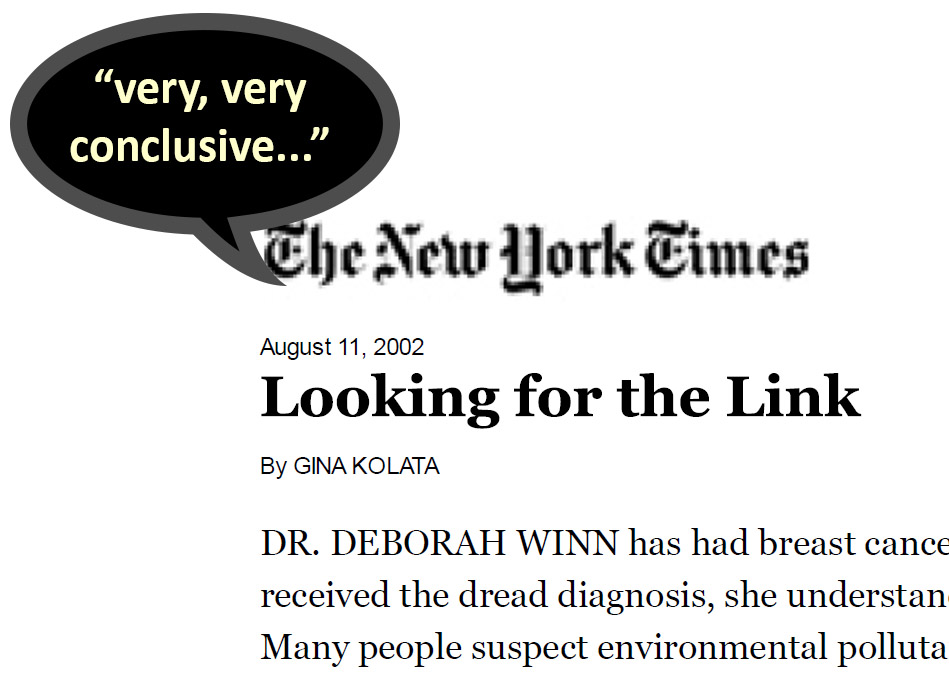
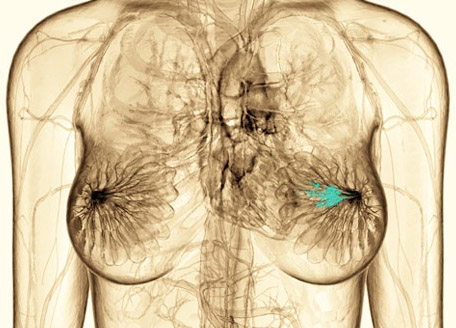
Since then, the surpluses have only gotten worse. During the 1950s the government was buying up more excess grain than ever, and trying to get some Cold War mileage out of it by shipping it to countries where the Soviets had a foothold. Still the surplus grew, accelerated by the spread of the insecticide DDT — which epidemiologists later found to have predisposed millions of girls to breast cancer later in life.

By 1960 the government was spending the equivalent today of $5.4 billion/year on grain storage [7]. The overproduction crisis was the biggest domestic issue in that year’s presidential race between Nixon and Kennedy, with both candidates claiming they could manage the problem (Figure <1960>).

But the problem was about to get much worse.

LIFE Magazine Sept. 26, 1960.

Post-WW2 America was awash in cheap fertilizer — mainly due to the “beating of swords into plowshares” by converting munitions factories to fertilizer production. Breeders found they could raise yields even further (!) by adapting corn hybrids to ever-more densely crowded fields, and plants would soon be planted twice as densely as in 1955 [4]. The packed plants could be heavily fertilized, but they also had to be pesticide-sprayed and well watered. A nation suffering from too much corn grown with too much pesticide now got even more corn grown with even more pesticide.

Forced onto the Dole

The forces that pushed the corn yields through the roof in the 20th Century forced a profound change in the economics of running a farm. Seed, which used to be produced on the farm, now had to be bought. Corn now required chemical fertilizer every year (which also undermined the natural fertility of soil, locking farmers into a fertilizer treadmill [8]). Pesticides also became a major expense, likewise addictive as insects and weeds developed resistance. Tractors were so expensive they required a mortgage, with relentless payments that eroded the financial flexibility farmers needed [9]. When GM crops came along, they too required an extra ante. While crop production, already excessive by the 1930s, began its inexorable climb in the 1940s, production costs climbed even more steeply. The “march of progress” made the industrial American farm increasingly impossible to operate without substantial government support, and programs for proliferated rapidly.

Which leads us to an interesting addition to the famous graph. The USDA provides the numbers on the different kinds of dole American farmers have relied on since 1933. If you download the data and put it into a chart (with some programs lumped for legibility) you get this:
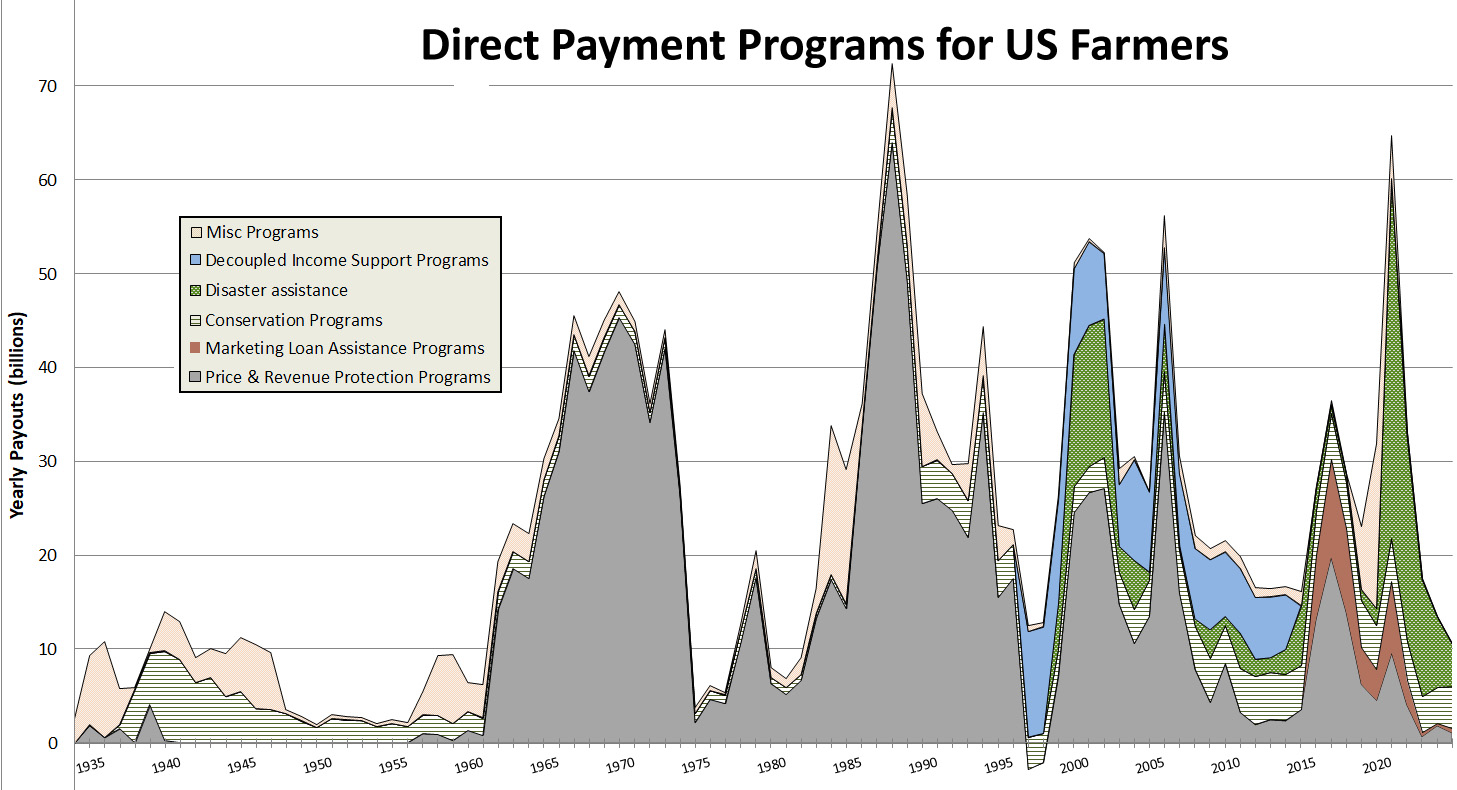
Out of morbid curiosity I put the payments into a cumulative graph to see how much the farmer dependency has cost us taxpayers 2.1 trillion. And a graph of the accumulated payments looks an awful lot like the famous climb of hybrid yields.

Even with this much dole, American farmers have still disappeared — gone under, gave up, or in many cases committed suicide. [12]

The famous chart’s rising line indexes a decades-long debacle for farmers, the government, the public, and the environment. The only winners have been the ever-expanding world of agricultural input industries.

How Did Farmers Get Into this Jam?

Predictions are hard, Yogi Berra once observed, “especially about the future.” If you could have told American farmers in the 1930s that the new hybrid seeds would play a key role in a century-long worsening of the agricultural surplus problem and the vanishing of most farmers, with the remaining ones heavily dependent on government aid, and that it had all been subsidized by taxpayer dollars, they would have been horrified. And yet they adopted the seeds. Why?

Well they didn’t at first. In fact, the whole field of research on adoption of technologies — “innovation diffusion” research — got its start in 1942 when Iowa breeders hired some sociologists to figure out why farmers were not adopting the new hybrids.

One reason was simple: even with publicly-supported breeders doing all that legwork to find winners for the seed companies, the hybrids were only marginally better than the conventional seeds. And they had to be bought every year. And they were pricey.

But hybrid corn enjoyed an unprecedented level of promotion by corn breeders. As employees of public institutions, the breeders were supposed to have the farmers’ interests at heart; but then again so had the selectionist breeders they had vanquished as they staked their careers on hybrids. And they had a powerful new means of getting into farmers’ ears: farm radio was spreading just as hybrids were being introduced [10].

And hybrid corn was being pushed by the full persuasive power of the federal government because the seed industry had infiltrated the USDA at the top: FDR’s Agriculture Secretary was none other than Henry A. Wallace, whose Pioneer Hybrid Seed Company was the nation’s largest seed hybrid seed seller.

Wallace wasted no time in putting the full weight of the Federal government behind a sustained propaganda campaign to promote hybrid corn — despite his glaring conflict of interest [13].
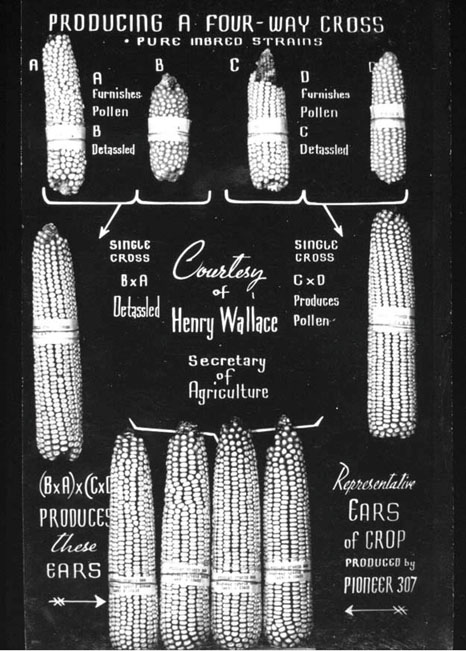
Promotional material by the founder of the Pioneer Hybrid Seed Company after he became Secretary of Agriculture.

Another factor was drought and desperation. The 1930s not only brought farmers the hardships of the Depression and the grain surplus, but a severe droughts in 1934 and 1936. Reeling from these compound threats to their livelihood, farmers in the Midwest began to hear that the new hybrids had weathered the drought better than conventional corn. In particular Pioneer’s new 307 hybrid was said to have had lower yield reductions. This kicked off a jump in hybrid adoption, which eventually led to what has been called a snowball effect. Farmers, it turns out, are surprisingly prone to bandwagons — and this is well documented [4, 14, 15].

Were hybrids really more resistant to the 1930’s droughts? Maybe , but then again the main source this claim was the Pioneer Hybrid Corporation, amplified by Secretary Wallace. Moreover hybrids’ “superior performance” would have been a textbook case of selection bias: it is known that the “early adopters” who were the first to try out hybrids tended to be the most successful farmers, the very ones who could afford to devote the most attention to the crops and probably even plant the fancy new seeds on their best land.

And by the mid-1930s, the conventional “selectionist” breeding that had served farmers so well for decades had shriveled to almost nothing as public institutions poured their resources into developing hybrids. In 1924, 99% of the entries in the Iowa Corn Yield test were OPV’s; by 1938 less than 6% were OPV’s [16].

Looking Ahead

If the input-intensive, over-producing corn hybrids were a disaster in the 20th century, they are likely to be even worse in the 21st. Notice that while corn yields certainly trend upward, they became highly unstable after the 1960s, with dramatic dips over and over again. The early hybrids may have been relatively drought resistant, but the water-intensive seeds that spread in the 1960s were anything but. In fact, a 2-week drought just when the crop is pollinating can easily cut production by a quarter; a continuous drought may result in 100 percent reduction. [17].

You would think that no farmer in their right mind would plant much of such a risky crop, but remember that American farmers are floating on a sea of supports and subsidies. Every time the hybrid yields crash, a plethora of government programs — like the Federal Crop Insurance Program, the Noninsured Crop Disaster Assistance Program, the Emergency Loan Program, the Emergency Commodity Assistance Program — open their wallets.

At the end of the day, we have not only spent a taxpayer fortune subsidizing farmers to use toxic chemicals to grow vast quantities of uneconomic and unneeded corn, but to do so with hybrids that are highly unstable in weather extremes.

In a world increasingly confronted with weather extremes.

And still we celebrate a chart of progress of hybrid corn.

References

1. Kloppenburg, J.R., Jr, First the seed: the political economy of plant biotechnology, 1492-2000, 2nd edition. 2004, Madison: Univ Wisconsin Press.

2. Just a few examples: Bórawski, P 2015 Multifunctional development of rural areas: international experience; Brummel, D  2022 A Brief History of Corn – From Domestication to 1995 (Pioneer website); Kloppenburg 2004 [above]; Kucharik, C and N Ramankutty 2005 Trends and Variability in U.S. Corn Yields Over the Twentieth Century. Earth Interactions – EARTH INTERACT 9; Larsen, J  2012 Heat and Drought Ravage U.S. Crop Prospects—Global Stocks Suffer. in Grist Magazine; Mitchell, P  2018 Corn Productivity: The Role of Management and Biotechnology; Nielsen, R.L. 2023 Historical Corn Grain Yields in the U.S., in Corny News Network. Purdue Univ.; Perry, M 2011 Corn Yields Have Increased Six Times Since 1940, in American Enterprise Inst.; Pesticide Guy 2014 Herbicide Adoption Contributed Greatly to Increased Corn Production, on Pesticideguy.org.

3. Stone, G.D., Skill Talk: The Struggle Over Agricultural Decision-Making. Outlook on Agriculture, 2025.

4.  Stone, G.D., The agricultural dilemma: How not to feed the world. 2022, London, New York: Routledge.

5.  Wallace, H.A., The year in agriculture: secretary’s report to the president, in Yearbook of Agriculture. 1934, USGPO: Washington, DC. p. 1-99.

6.  Culver, J. and J. Hyde. 2000. American Dreamer: The Life and Times of Henry A. Wallace. New York and London: W.W. Norton, pp. 123–124.

7. Cullather, N., The hungry world: America’s cold war battle against poverty in Asia. 2010, Cambridge MA: Harvard Univ. Press.

8. Montgomery, D.R., 2020 visions: Soil. Nature, 2010. 463(7277): p. 26-32.

9. Fitzgerald, D., Every farm a factory: the industrial ideal in American agriculture. 2003, New Haven & London: Yale Univ Press.

10. Novaes de Amorim, A., Agricultural Change in the United States: Evidence from the Golden Age of Radio. 2023: Unpublished paper.

11. Fitzgerald, D., Farmers Deskilled: Hybrid Corn and Farmers Work. Technology and Culture, 1993. 34: p. 324-43.

12. For instance, see Gunderson, P., et al. The Epidemiology of Suicide Among Farm Residents or Workers in Five North-Central States, 1980–1988. American Journal of Preventive Medicine, 1993, 9(3), 26–32. This multi-state analysis (1980–1988) of five Midwestern states reported exceptionally high suicide rates among male farmers — annual rates ranging from roughly 42 to 58 per 100,000, far above other farming groups​. Farmers and ranchers were about 1.5 to 2 times more likely to die by suicide than other U.S. men.

13. Sutch, R., The Impact of the 1936 Corn Belt Drought on American Farmers’ Adoption of Hybrid Corn, in The Economics of Climate Change: Adaptations Past and Present, G.D. Libecap and R.H. Steckel, Editors. 2011, University of Chicago Press: Chicago. p. 195-223; Sutch, R.C., Henry Agard Wallace, the Iowa Corn Yield Tests, and the Adoption of Hybrid Corn. 2008.

14. Stone, G.D., A. Flachs, and C. Diepenbrock, Rhythms of the herd: Long term dynamics in seed choice by Indian farmers. Technology in Society, 2014. 36: p. 26-38.

15. Stone, G.D., Agricultural Deskilling and the Spread of Genetically Modified Cotton in Warangal. Current Anthropology, 2007. 48: p. 67-103.

16. Robinson, J.L. and O.A. Knott, The story of the Iowa Crop Improvement Association and its predecessors. 1963, Ames IA: Iowa Crop Improvement Association. 269 p.

17. Berglund, D., G. Endres, and D.A. McWilliams Corn growth and management. North Dakota State University extension, 2020.

Posted in Agriculture, Food, Industrial Agriculture | Tagged , | Leave a comment

Good Luck with the Corn, RFK You A-hole

Hard to imagine an odder way to start the day than sympathizing with Robert F. Kennedy Jr., but that’s what happened as I read about his “war on corn syrup.”

Corn processors’ defense of High Fructose Corn Syrup (HCFS) — “sugar is sugar” — may be partly true from a strictly nutritional standpoint, but cane sugar and HFCS have very different deep histories that RFK (and you, gentle reader) should know about.

The deep history of cane sugar is told in one of the truly wonderful books from my field of anthropology, Sidney Mintz’s Sweetness and Power.  It’s easy to assume that the world consumes so much sugar simply because of the human sweet tooth, but Mintz shows that the real driver has not been taste buds but slavery. Before the 1600s, sugar was not a basic ingredient or even a spice – it was rare and valuable stuff made into fancy treats for the rich and the royal. But the 1600s brought the ramping up of the slave trade, and a new class of wheeler-dealers who had an embarrassment of riches in the form of coerced human labor.  So much of it, in fact, that they – in collusion with European powers – invented a whole new form of production: the factory farm. Well the proto-factory farm anyway. Sugar cane could be grown and processed very intensively with copious amounts of unskilled slave labor on Europe’s scattered “sugar colonies.”

The problem of how to profit from all the slave-produced sugar led to vast increases in rum production, and to growing trade in bitter things made better by a spoonful of sugar – chocolate, coffee and tea. By the 1800s, factory owners in England found that giving exhausted workers an afternoon tea break for a hit of calories and caffeine squeezed more work out of them – hence “tea time”.

For European powers, sugar colonies were just the start; their economies grew by sucking resources out of colonies as raw inputs into those factories where tea-drinking workers made cloth from cotton, chocolate from cacao, furniture from lumber, and so on. And their populace ate grains and meat from their colonies, produced by coerced “colonial subjects.”

But the US, lacking colonies, followed a very different macro strategy: the integration of manufacturing with agriculture1. This came into full flower in the 20th Century as waves of government subsidy underwrote agricultural industry after industry – fertilizer, hybrid seeds, tractors, pesticides, GM crops, and so on.

Old Henry Ford started selling tractors just a few years after the Model T came out. Of course today farms are much bigger so they all need tractors, but not in the early 1900s. Actually many farmers were coerced into buying them. The new breed of “agricultural engineers” at state universities pushed them, and banks preferred to make loans to tractor owners. Great book on this: Every Farm a Factory.

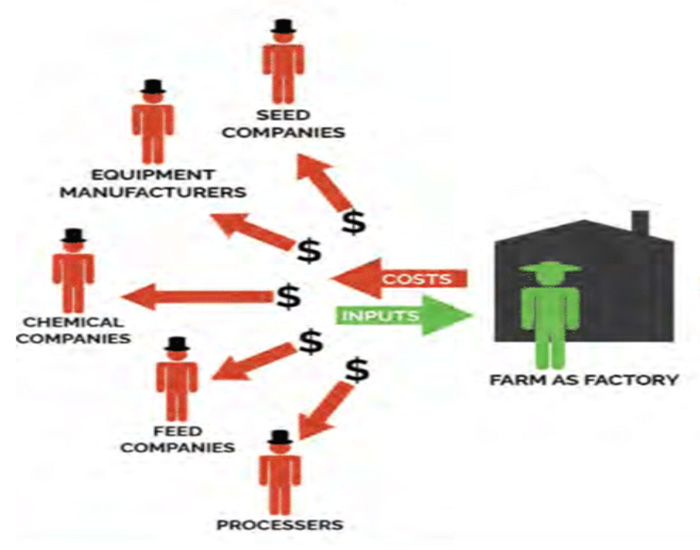
The reason America’s industrialization of agriculture is a big deal economically is that each agricultural input industry supports secondary and tertiary industries. The fertilizer industry supports factory builders,  chemical companies, gas pipeline and fracking companies, trucking and shipping companies; the tractor industry supports steel producers, fuel companies, tire and rubber industries, engineers, computer makers, and so on. The high cost of running an American industrial farm – where a tractor alone can easily run $150,000 – requires credit, which supports the banking industry. Input industries also support research universities, where scientists develop more technologies, economists study the technologies’ benefits, and the occasional anthropologist writes about the whole system.

Most of the economic activity being funneled onto farms is indirect, so it’s impossible to arrive at a good estimate of the collective value of the enterprise, but the USDA reports that in direct costs alone (that is, excluding all that money circulating through secondary industries) American farmers these days spend $22 billion on fertilizer, $12 billion on fuel, $22.2 billion on seeds, $12.6 billion on tractors and other self-propelled farm machines, and $9.9 billion on interest. Almost all of this money flows OUT of the communities where the farms are and into the pockets of shareholders of Shell, Bayer/Monsanto, John Deere, etc.

The government keeps the whole system going by subsidizing the farmers and the companies alike in various ways, and of course the companies buy political influence to keep the government doing just that.

One result of this political-economic clusterfuck has been a century of wild overproduction. The US has been paying farmers to reduce production ever since the New Deal, but it has never been able to rein in the overproduction caused by its lavish support of ag input industries. Corn overproduction has been especially perverse, with breeders developing high-fertilizer high-pesticide hybrids at the same time overproduction was surging.

If maximizing profiting from slave labor in the 17th and 18th centuries led to English tea time, profiting from excess corn in the 20th led to farmer payoffs, HFCS, hellish feedlots, ethanol laced gas, and other regrettables. The Omnivore’s Dilemma does a great job explaining what has unfolded since WW2, but those developments were all set up by the much deeper history. The Agricultural Dilemma shows how the government gave lavish support to agricultural industries starting in the early 20th century – undermining the more sustainable forms of agriculture that would have fed us just fine.

The point is that hundreds of businesses, laws, political allegiances, rural landscapes, and even the American palate have been shaped by this history for a century now. Our national integration of agriculture is the country’s biggest and most dysfunctional case of path dependence. Bummer that HFCS makes us fat and diabetic, but it’s part of a system that long ago metastasized throughout our economy. Poor RFK, that’s what he’s up against: its deep history.

Don’t get me wrong: RFK is a quack and an asshole. Normally we only become “food for worms” when we die, but RFK’s brain has already been a buffet for pork tapeworms. If we have another epidemic, many may die because of the bug he has up his ass about vaccines. But in his attack on the toxic zeacentric American agrifood industry, I wish him well.

But let’s not hold our breath.

NOTES

1. For more on this, see P. McMichael 2000 Global food politics. In Hungry for profit: the agribusiness threat to farmers, food, and the environment. Magdoff, Foster, and Buttel, eds., pp. 125-143.

Posted in Agriculture, Food, Industrial Agriculture, Public Health | Tagged , , , , | 2 Comments

Bonus Eventus and Childless Cat Ladies

Interested in how the government spends your taxes? Well in the case of the US, I’m flattered to say the federal government has been spending it on me. But it does it in two very different ways.

First, it pays for my scientific research. This is done through grants from the competitive process at the National Science Foundation, supporting empirical research on sustainable agriculture in Africa, on genetically modified crops and pesticides in developing countries, on agricultural decision-making in India, and on digital agriculture for smallholders.

Then, when some of my research findings are at odds with industry claims, it pays for an agrichem industry PR firm to compile an oppo-research dossier on me.

This second expenditure originates from the US Agency for International Development, an independent federal agency associated with the State Department.

My dossier lives on a private internet platform available only to invited subscribers. It lists my employer, my family members, home address, and quotes from what I will politely call a propaganda website, like “Professor Stone wears his bias on his sleeve while pretending to be objectively critical but few are fooled.” But it then lists 30 of my peer-reviewed articles in apparently easy-to-fool scientific journals like Nature Plants, Journal of Agrarian Change, Human Ecology, World Development, and Current Anthropology.

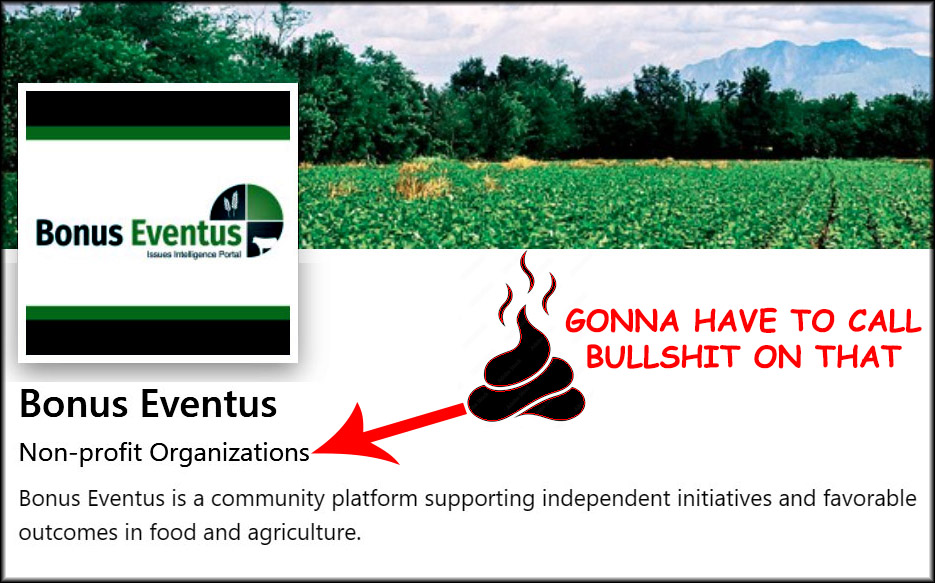
This oppo-research platform has a name: Bonus Eventus, I shit you not. (Does this not sound like a porn star screen name? Now appearing in Hot and Horny Green Activists…). Although literally translated as “good outcome,” Bonus Eventus was a Roman god of agriculture, but kind of an also-ran god. Ceres had the top job and she concerned herself with weighty issues of fertility and cycles of life and death; Bonus was the guy you sacrificed a rooster to give your barley crop a boost.

I still think Bonus Eventus sounds like a porn star, and the depictions of him do nothing to disabuse me of that notion.

Bonus boasts dossiers on over 3000 organizations and 500 individuals who have said or written something about pesticides or GMO’s. The obvious (and only conceivable) use of this trove of tea is as ammo for denigrating and attacking anyone critical of GM crops or pesticides.

I have no idea how any of this has been, or will be, used against me, but I know that in the world of critics, I’m small potatoes; Bonus has much fatter dossiers on some science writers (they seem obsessed with Michael Pollan), lawyers (like members of the UN Panel on Food Security), and scientists galore.

Bonus and the company behind it, v-fluence, are the spawn of Jay Byrne, a former Monsanto comms flack – turned media hitman. Jay fashions himself as a “public relations executive.” This is technically true, although in the world of PR he’s like the enforcer on an NHL team — the toothless thug who can’t pass or score but lives to smash opponents into the boards.

What’s amazing is how many of the people they smash into the boards are scientists or science writers — given that industry’s long-standing insistence that agrichemical and GMO controversies pit science against anti-science activists. Industry claims to be the scientists, the ones trying to feed the world with safe and effective modern agricultural technologies; the critics are the activists, ignorant dreamers, stooges for Big Organic, yoga teachers. They have been beating this drum for years, but the recent revelations about Bonus put it in a new light. I provide links below, but first let me entertain you with a glance back at the agrichem industry’s history of scientist-bashing. This is a deep and ugly history but I’ll stick to two of my favorite highlights.

The Bonus Eventus website. “Favorable outcomes” for agrichemical industry activists maybe, but not for science.

1. Getting Loud about Silent Spring

Rachel Carson’s 1962 best-seller Silent Spring sounded the first major warning of the environmental dangers of the rampant post-WW2 use of agricultural pesticides — especially DDT. This was the agrichemical industry’s first major public brush with skepticism from scientists (yes, Rachel Carson was a scientist, although Silent Spring was a trade book). The smear-the-scientist strategy was hatched to deal with the Rachel shitstorm. DDT producer American Cyanamid took the lead, fielding the mustachioed academic biologist Robert White-Stevens to roam the country in a lab coat denouncing her book as distorted, inconsistent with “modern science,” and Carson herself as “a fanatic.”

Get the popcorn and watch this blowhard set you straight on Rachel Carson. Robert White-Stevens was originally a professor at Rutgers who did research for agribusiness products like antibiotics as animal growth promoters. After becoming full-time Rachel-basher at American Cyanamid, he was a pesticide activist, penning such classics as “Pesticides: Friends or Enemies” (care to guess which?) and “DDT Ban: A Judgment of Emotion and Mystique.” Dr. Robert, according to his obit, enjoyed a heaping spoonful of DDT with his morning coffee, “to illustrate to students that what they were hearing about ecology and about saving the environment might be a lot of hoopla.”

A few years later, Green Revolution hero Norman Borlaug piled on. The tireless agrichemical promoter lit into the “vicious, hysterical propaganda campaign … by fear provoking, irresponsible environmentalists” like Rachel Carson’s “diabolic, vitriolic, bitter, one‐sided attack on the use of pesticides”.

But this was industry on the high road. More commonly, as Patricia Hynes notes, “industry and government aimed to discredit the book by discrediting the woman” — they “sexualized their contempt for her.” In an eerie prequel to JD Vance’s diatribes on childless cat ladies, one editor accused her of worrying more about cats’ deaths from DDT than children’s deaths, while another said that he “thought she was a spinster {code for lesbian}, so what’s she so worried about genetics for?” She was branded dangerous, irrational, and of course hysterical.

Rachel actually did have a cat. And no kids! How does it make any sense that we’ve turned our country over to people who don’t really have a direct stake in it?

Ah yes, hysterical — the h-bomb in agrichem counter attacks and the uber-slur for female critics, from the Greek hystera for womb. Women scientists are either hysterical or the cause of hysteria. Hippocrates himself was the original source on hysteria, but it wasn’t PMS he thought made women spout nonsense — it was their uterus wandering around inside. Plato further proposed that it was the frustrated unproductive uterus that wandered off and knocked the woman off her game. And that Plato was one smart cookie, so maybe childless cat ladies really are unreliable interlocutors.

But no, it was the cool, collected, childless feliphiliac on whom scientific history would smile, not the agrichemical apologists with their apoplectic, spittle-flecked, misogynistic screeds. DDT’s ecological impacts were as bad as Carson warned but its impact on human health turned out to be worse than she could have known. In 1962 she could cite no evidence that the pesticide was a human carcinogen, but four decades after her death, it was shown conclusively to be a potent cause of the very disease that killed her — breast cancer.1

2. Chapela and the Sock Puppets

Sounds like a late-60s indie rock group doesn’t it? It isn’t. In 2001 Berkeley ecologist Ignacio Chapela and his student David Quist reported in Nature that GM corn had contaminated (“introgressed”) native corn varieties in Mexico. The GM/pesticide industry, already reeling from the hostility its products had encountered in Europe, was furious. The day the paper was published, the AgBioWorld listserv (read by >3000 scientists) lit up with ad hominem attacks, most stridently by new contributors named Mary Murphy and Andura Smetacek. They insisted that Chapela was biased, an activist, just out to make money from speaking fees by fear-mongering. Moreover, organizations that criticized GM crops were “terrorists.”

Mary and Andura did not sleep. They relentlessly attacked Chapela in personal terms, and then directed readers to the Center for Food and Agricultural Research, whose website had the straight dope on all this anti-GMO “activism.” The CFFAR website featured two happy brown-skinned kids in a farm field, but its content was mainly decidedly unhappy snarling denunciations of the GM/pesticide industry’s perceived enemies, including many scientists. (E.g., Michael Hansen was “the crown prince of cancer scares” and a Commie-lover.)

But it didn’t take much sleuthing for British writer George Monbiot to trace Mary Murphy and Andura Smetacek back to Bivings Woodell — a PR firm that prided itself on promoting messages in the guise of “an uninvolved third party.” (It was working for Monsanto, whose chief internet strategist at the time was our pal Jay Byrne.) When Monbiot emailed Murphy, “she” only replied that she had “no ties to industry”. LOL; neither she nor Andura actually had ties to anything, even corporeal existence — they were fictitious personae, invented by nattering nabobs hired to mug scientists.

Ditto for the CFFAR — no office, no staff, and no earthly existence beyond the flimsy website festooned with attacks on GM critics. The URL was registered to a Bivings exec. It, along with its imaginary henchwomen, suddenly vanished, never heard from again. Raptured to Sock Puppet Heaven perhaps.

After a bit, the URL was replaced by a placeholder urging one to “sip a clean cup of herbal tea”

The PR firm’s CFFAR website before it went poof. It’s hard to say who the kids were or what they were up to, but I was studying cotton farmers in Andhra Pradesh at the time, and I swear this looked like two Indian kids in a hybrid cotton field. If so, those “ain’t we got fun” grins would have been fleeting. Producing hybrid cotton requires an enormous amount of menial labor, 88% of which in A.P. is performed by kids aged 6-14. It is hot and tedious work in pesticide-drenched fields for almost no pay.

Because of his scientific research — plus his vocal opposition to a controversial deal whereby UC-Berkeley sold rights to his department’s research findings to a biotech firm — Ignacio Chapela left a throng of fist-waving critics in his wake. But his finding that transgene contamination of native maize would eventually be confirmed — repeatedly.2 Chapela was a sometime activist, but his Nature paper was science.

It’s News. But is it New?

This Bonus Eventus is news, but is it something new under the sun? Well yes and no.

The fact that it was exposed and found to be newsworthy in publications like those listed below is new and surprising. Kind of amusing too, to see so many of the entities who subscribed to it head for the exits (shouting over their shoulders that they didn’t set it up! never even logged in! well not much anyway!). But ad hominem attack has been agrichem’s go-to response since scientists began questioning their products.

Getting academic individuals and institutions to suit up and help has been surprisingly easy too — that’s not new. Universities are just as money-hungry as corporations, and lab science faculty have to be professional money-raisers — but they appear to be cloaked in scientific objectivity. Academic scientists “have a big white hat in this debate,” as a PR exec gushed to an academic recruit to the battle against critics.

A big white hat and an even bigger tin cup. The Gates Foundation — the world’s richest philanthropy — paid for an agrichem propaganda operation to demean science that diverges from industry claims. It’s called the Alliance for [you guessed it…] Science and it is housed at Cornell University. For instance, see Alliance employee Mark Lynas’ Seeds of Science. The whole point of this turd of a book is to pump up Lynas into a former anti-GMO leader (LOL he wasn’t) who somehow awoke from his demented green slumber to expose his former comrades as “grungy” activists who don’t know what DNA is (Mark didn’t). As this droll review shows, he focuses on a small handful of campaigners in an attempt to whisk from view the enormous body of critical peer-reviewed research from natural and social scientists.

Thus, behold the sorry spectacle of an Ivy university pimping out its respectability in exchange for a bagful of benjies. (Just like my old employer Washington University, which slurped it on down when fossil fuel companies threw it a bone to house a greenwashing “clean coal” institute. The Wash U faculty was docile about it all, but not the undergrads, who routinely showed up to spray a shit mist over “clean coal” events. But I digress.)

The Gates-funded “Alliance for Science” has been a spigot of corporate talking points on GMO’s and trash-talking any critical findings. Apparently any science that might endanger biotech industry profits must be a “conspiracy theory”, to be equated with climate change denial.

How about sponsorship from the US government — new? Well direct payments to an agrichemical PR firm would be new, but that’s not technically what happened. The USAid, which is all in when it comes to helping US companies sell agrichemicals in the Global South, made out their check to the International Food Policy Research Institute. IFPRI, like all centers in the CGIAR international agricultural research network, claims to care only about “hunger and poverty”, but it understandably cares even more about its own poverty. As funding has steadily dried up and positions axed, these centers have increasingly resorted to turning tricks, directly or indirectly, for the agrichemical industry. So USAid venmo’ed IFPRI $400,000+ which IFPRI then venmo’ed v-fluence to go through critics’ laundry.

I’m the last person to argue that it’s new for the government to spend money to buck up chemical agriculture. My recent book The Agricultural Dilemma is all about how industrial agriculture arose because of the shared interests of government and agricultural input companies, but at the expense of environment, public health and appropriate levels of food production. So in a general sense, no, not new at all.

But in a specific sense — well a personal sense — it feels new. After funding my scientific research, my government funded a propaganda platform concocted by a Monsanto bagman to pore through my publications for tidbits to take out of context — the only purpose of which would be to help industry stooges smear me. Obviously other scientists are welcome to debate my work, but they hardly need anything on Bonus to do so.

So hey, other scientists and science writers — how has the US spent money on you?

Now for the Investigative Journalism

The new reporting is the fruit of a collaborative effort by those rare and wondrous (and critically endangered) beasts, investigative journalists.

The badass reporters at Lighthouse Reports did most of the shoe leather work — including FOIA requests, money-trails analysis and public spending record searches. Margot Gibbs and Elena DeBre get major credit for this work, and let us raise a glass to them.

They collaborated with journalists at major outlets across the globe, leading to a set of articles that each explored different areas of interest, including:

THE NEW HUMANITARIAN considers the industry push for pesticides into Africa (like paraquat…Parkinson’s Disease, anyone?)

THE GUARDIAN‘S coverage by Carey Gillam (of Whitewash fame) is good on machinations within the US government, from USAID to the White House Writers’ Group.

LE MONDE published a 3-part series by the ever-inquisitive Stéphane Foucart
-> Investigation Reveals Mass Profiling includes more on specific scientists targeted on Bonus
->Diving into the Black Box of Global Pesticide Propaganda includes entertaining denials by subscribers that they had anything to do with v-fluence
-> and How Trump’s Administration tried to Torpedo the EU Green Deal using Influence and Misinformation Campaigns is great on, well, how how Trump’s administration tried to torpedo the EU Green Deal using influence and misinformation campaigns.

Notes

1. The go-to for current research on long-term health effects of DDT is the UC-Berkeley epidemiologist Barbara Cohn and her collaborators. After many studies failed to identify a carcinogenic effect for the pesticide, Cohn’s team found a way to compare adult health to pre-puberty exposure to DDT, and boom — it’s carcinogenic as hell.

2. Quist and Chapela’s 2001 paper also claimed that in some cases the transgenic DNA construct had broken apart, a finding that since been discounted. The much more important finding of introgression has been confirmed repeatedly:

Piñeyro-Nelson, A., et al. (2009) “Transgenes in Mexican maize: molecular evidence and methodological considerations for GMO detection in landrace populations.” Molecular Ecology 18:750–761.
González, C. A., et al. (2016). “Genetic diversity and presence of transgenes in Mexican maize landraces.” Molecular Ecology Resources, 16(3), 628-639. doi:10.1111/1755-0998.1246
Arriaga, A., et al. (2020). “Transgenic contamination in maize landraces: A case study from Oaxaca, Mexico.” Plant Genetic Resources, 18(4), 275-282. doi:10.1017/S147926212000019X
Zavala, J. A., et al. (2019). “Detection of transgenes in maize landraces in southern Mexico: Implications for agricultural biodiversity.” Environmental Biology of Fishes, 102(1), 45-57. doi:10.1007/s10641-018-0841-6
Mora, L., et al. (2021). “Survey of transgene presence in maize populations across Mexico.” Journal of Agricultural and Food Chemistry, 69(10), 3071-3080. doi:10.1021/acs.jafc.0c07399
Posted in Food | 2 Comments

Bt Cotton in Africa: What Happened in Burkina Faso?

As stories about GM crops in developing countries unfold, I continue to be struck by how very different each case is.  Despite the desire for simple global narratives of success or failure, the crops differ, the transgenic traits differ, the problems to be solved differ, the cultures differ, and the issues differ. Science can publish papers on Bt cotton test plots in India with titles like “Yield effects of genetically modified crops in developing countries”, but those test plots don’t actually tell you anything about “genetically modified crops in developing countries,” they just tell you about Bt cotton test plots in India.  As I have written elsewhere, Indian cotton is a unique situation [1] – very different from Bt cotton in South Africa [2], GM eggplant in India [3], Golden Rice in the Philippines [4], banana in Uganda [5], and so on.

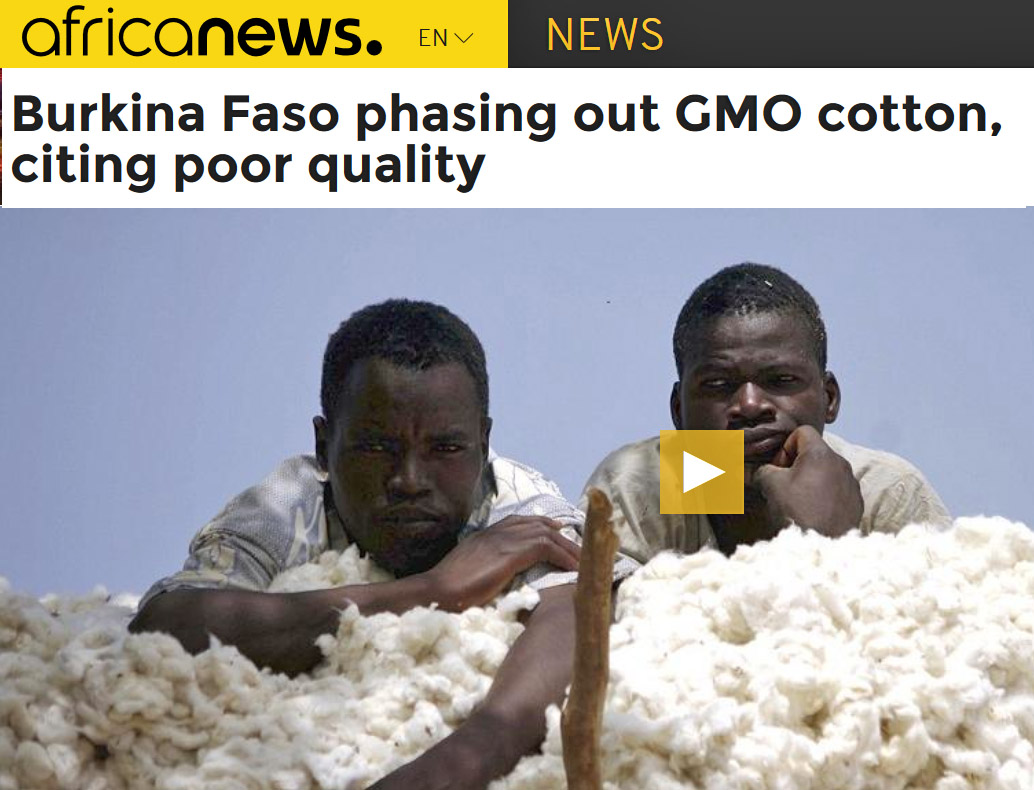
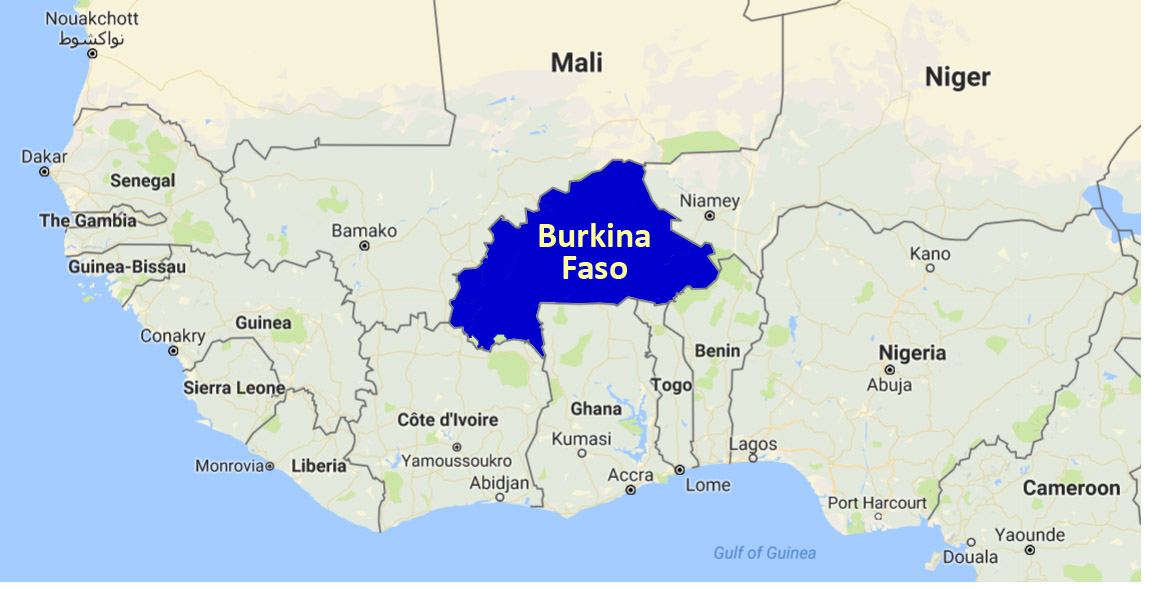
For many years there has been publicity BURKINAabout Bt cotton growers in Burkina Faso, much of it listing the outstanding benefits across the board.  But a few months ago, suddenly the news was “Burkina Faso phasing out GMO cotton, citing poor quality.”   Cotton companies are even suing Monsanto.

I’m an outside observer here – my research on African agriculture was in Nigeria and it was before GM crops came along.  But I know some scholars who follow these events closely.  Brian Dowd-Uribe (International Studies, Univ San Francisco. ) and Matthew Schnurr (International Development Studies, Dalhousie Univ) have written extensively on GM crops in subSaharan Africa and have already published a short piece  on the implications of what’s happening in Burkina. Now they have agreed to provide this guest blog which provides the interesting backstory of what is happening.  Once again, it is a very particular story: it has to do with colonial-era breeding, quality of lint (the fibers that are separated from seeds, from which thread is made), and the particular way they grow cotton in Burkina.

Thanks to Brian and Matthew.

GDS

NOTES
[1] For analyses of the unique situation in India, see Stone 2015 “Biotechnology, Schismogenesis, and the Demise of Uncertainty,” Journal of Law & Policy 47:29-49; Stone et al. 2014 “Rhythms of the herd: Long term dynamics in seed choice by Indian farmers,” Technology in Society 36:26-38; Stone 2012 “Constructing Facts: Bt Cotton Narratives in India,” Economic and Political Weekly 47(38):62-70; Stone 2007 “Agricultural Deskilling and the Spread of Genetically Modified Cotton in Warangal,” Current Anthropology 48:67-103. All are available here.
[2] Witt H, Patel R, Schnurr M. 2006 “Can the Poor Help GM Crops? Technology, Representation & Cotton in the Makhathini Flats, South Africa,” Review of African Political Economy 109:497-513.
[3] Kudlu C, Stone GD. 2013 “The Trials of Genetically Modified Food: Bt Eggplant and Ayurvedic Medicine in India,” Food Culture & Society 16:21-42.  Available here.
[4] Stone GD, Glover D. 2016 “Disembedding Grain: Golden Rice, the Green Revolution, and Heirloom Seeds in the Philippines,” Agriculture & Human Values 33(1):online.  Available here.
[5] Schnurr MA. 2013 “Biotechnology and bio-hegemony in Uganda: unraveling the social relations underpinning the promotion of genetically modified crops into new African markets,” The Journal of Peasant Studies 40(4):639-58.

Burkina Faso’s Bt cotton reversal: Why Africa’s largest producer of GM cotton is phasing out production and what this means for GM crops in Africa.

Brian Dowd-Uribe and Matthew A. Schnurr*

In 2003 Burkina Faso, in partnership with Monsanto, began development of Bt cotton. At the urging of Burkinabè cotton sector officials, Monsanto agreed to backcross the Bt gene onto local varietals, which were then released to farmers in 2008.

At first, the introduction was hailed as a westafricasuccess with farmers enthusiastically adopting the technology.  But despite the many published claims of agronomic and economic success for these farmers, if you look at the actual  empirical inquiry into the Burkina Faso situation you find trouble.  The main evidence of Bt cotton outcomes in Burkina Faso comes from a group of Monsanto-funded studies conducted by one research team. Their early studies from 2009 showed that Bt cotton produced yield gains of 18.2 %, which boosted profits despite higher Bt seed cost. However these studies did not report how those yield advantages were calculated. Later studies drawing from the same household surveys reported that an average Bt cotton farming family gaining 50% more profit than from conventional cotton.  Glenn Stone found that the authors of these studies calculated the yield differences by comparing Bt cotton with refugia planted with conventional cotton. Comparing with refugia is problematic, since farmers devote little attention to them; the purpose of refugia is to grow caterpillars that aren’t resistant to Bt. Moreover, farmers do not harvest refugia separately from the rest of the field, so it is a mystery where the numbers for conventional yields came from.

Nonetheless, most farmers were enthusiastic about Bt cotton primarily as a tool to save valuable labor time. Bt cotton requires significantly less pesticides reducing labor needs at critical moments in the growing season. By 2014, more than 140,000 smallholder farmers were cultivating Bt cotton, representing 70% of total cotton production in one of Africa’s largest cotton producing nations.

But recently the success story of Bt cotton’s adoption came to an abrupt end. In 2016, Burkinabè cotton officials claimed that the Bt cotton varietals produced lint of inferior quality resulting in tens of millions of dollars in lost revenues. The Bt cotton lint fetched lower prices on the global market and undermined the global reputation of high quality Burkinabè lint.

Since then, the Burkinabè cotton sector has moved swiftly to reduce Bt cotton sowings. For the current 2016/2017 growing season approximately 10% of total production is from Bt cotton. A complete phase out is planned for next season.

What went wrong with what was supposed to be an example of the potential benefits of GM crops for resource-poor farmers in Africa?

Lint qualitylint

The first part of the explanation concerns lint quality. High lint quality is Burkina Faso’s competitive advantage on the global cotton market. Most cotton in the world is machine picked, which ends up producing shorter fibers of lower quality. Handpicking, which is practiced throughout Africa, keeps the fibers in tact, allowing them to retain their length and sturdiness, setting most African cottons apart from global competitors like the USA and Australia.

Both cotton fiber quality and cotton fiber efficiency (a measure of the amount of lint that can be extracted from each pound of cotton) are products of a decades-long breeding program that began during the French colonial era. Because of this breeding program, Francophone African cotton fibers have earned a reputation for high quality and efficiency. — by the mid-2000s Burkina Faso achieved some of the highest cotton efficiency ratings in the world. It is because of these high quality and efficiency characteristics that Burkinabè officials asked for the Bt gene to be backcrossed into their renowned local cotton varietals.

Unfortunately the quality characteristics of the original Burkinabè varietals were not retained when crossed with the Bt gene. Internal fixes were attempted but didn’t succeed in reversing this problem. In 2016, Burkinabè cotton companies pulled the plug on the entire program after incurring significant economic losses.

But the lower lint quality did not directly hurt cotton farmers. They continued to reap improved yields and incomes with lower labor requirements. Rather, the losses were shouldered entirely by the cotton companies. Why then would cotton farmers, who apparently like the technology and want to continue to cultivate it, stop growing Bt cotton? The answer is that they don’t have a choice.

Farmers’ lack of choice

Unlike other GM crop producing nations, cottonseed is entirely controlled by cotton companies in Burkina Faso. This means that farmers can only grow those seeds that are provided to them by the cotton company. Seeds are not saved in Burkina Faso because farmers are paid by weight, and extracting the seeds would reduce that weight

Under pressure to liberalize its cotton sector in the 1990s, Burkina Faso split its territory into three exclusive zones for three cotton companies, avoiding the rapid and comprehensive privatizations of the cotton sectors of its Anglophone African neighbors. In each of the three exclusive zones, one cotton company provides seed and inputs on credit to farmers at the beginning of the growing season, and then buys back the cotton at a fixed price at the end of the season. These vertically integrated systems, a product of the French colonial era, have been hailed as a major driver of agricultural productivity in large parts of Francophone Africa. Today the largest cotton company, SOFITEX, which is primarily state-owned, controls over 80% of Burkina Faso’s total cotton production.

Dowd-Uribe.Field.Trial.Oct.07.BF

Burkina Faso’s reversal and the implications for Africa

So what does this reversal mean for the future of transgenics in Burkina Faso and Africa more generally? In the short term transgenic cotton will no longer be an option for Burkinabè farmers since cotton companies will continue to control seed supply. It does not appear, however, that this reversal has reduced Burkina Faso’s interest in GM crops more generally or in GM cotton specifically. Burkina Faso continues to do research on transgenic varieties of cowpea. Cotton sector officials have also indicated their willingness to continue to research transgenic varietals so long as they retain desired quality characteristics, and have recently reached out to Bayer CropScience as a potential partner in developing such varietals. Nonetheless any re-introduction of transgenic cotton in Burkina Faso is likely to receive far more scrutiny, potentially delaying introductions.

One outcome of Burkina Faso’s reversal is the tarnishing of the image of GM crops as precise and universally beneficial. GM crop breeding, like other forms of breeding, can still result in unintended consequences that must be carefully analyzed and mitigated. In this case the introduction of transgenics transformed Burkina Faso’s cotton breeding program in two significant ways. It shifted the focus of breeding efforts from producing varietals that exhibited a diversity of quality and local adaptation characteristics, to a more narrow focus on pest resistance. Although pest resistance is a welcomed trait, neither cotton companies nor farmers are likely to consider it the most desired trait for breeding efforts. It also shifted breeding efforts from being exclusively public in nature to a more privately driven endeavor. The private nature of transgenic research resulted in varietals that were rushed to market. Instead of spending the money and time to ensure that desired quality characteristics were maintained, Monsanto and their cotton company partners released the Bt cotton varietals to farmers. This dynamic of desiring a quick return on investment is likely to accompany other GM crop introductions in Africa.

The lint quality controversy exposes the different interests for Burkinabè farmers and cotton companies. The reversal on Bt cotton shows the continued power of the state-run cotton company, something the World Bank has long attempted to curtail. It also opens a rift between the cotton companies and the very types of more mechanized and ‘professional’ farmers they have spent decades grooming who desire to continue growing Bt cotton. It is unclear how this apparent rift will be resolved. Larger, former Bt cotton farmers are likely to continue growing conventional cotton. However, according to interviews with farmers, they are likely to reduce the size of their plantations given the additional labor demands of conventional cotton. This may result in reduced cotton production in Burkina Faso, not simply due to the lower overall yields of conventional varietals, but also due to reduced sowings.

GM crop advocates would like to minimize Burkina Faso’s reversal on Bt cotton as simply a one-off problem that isn’t likely to reproduce itself elsewhere. Nonetheless, the Burkina Faso reversal may give pause to other large cotton producing African nations – countries like Mali, Cote d’Ivoire, Cameroon, Benin, Zambia and Zimbabwe – where high quality cotton is a significant market advantage. However, Nigeria’s recent approval of Bt cotton may signal that African countries are still willing to go ahead with this technology despite problems in Burkina Faso. It remains to be seen how this controversy will affect adoption of GM cotton in other nations slated to adopt this technology in the coming years such as Uganda, Ghana and Kenya.

*Brian Dowd-Uribe is Assistant Professor in the International Studies Department at the University of San Francisco. His current research explores the social, agro-ecological and economic dimensions of food, agriculture and water policy in sub-Saharan Africa and Central America. Dr. Dowd-Uribe’s primary geographic area of expertise is Burkina Faso, where he has conducted field-based research on questions of agricultural development since 2005.
Matthew A.  Schnurr is Associate Professor in the Department of International Development Studies at Dalhousie University in Halifax, Nova Scotia, Canada.  His current research investigates the potential for GM crops to improve yields and livelihoods for smallholder farmers across Africa.  He has undertaken field-based research in Uganda, Kenya, South Africa, Burkina Faso and Ghana.
Posted in Africa, Agriculture, Biotechnology | Tagged , , , , | 12 Comments

CRISPR and the Monsanto Problem (GMO, be some other name!)

‘Tis but thy name that is my enemy;
Thou art thyself, though not a GMO.
What’s GMO? it is nor hand, nor foot,
Nor arm, nor face, nor any other part
Belonging to a man. O, be some other name!

If gene editing isn’t on your radar yet, it will be. Tools for gene editing (genome editing) have been around for over a decade, but the new one – “CRISPR-Cas9” — is so much more quick, cheap and powerful that it is sending shock waves throughout the scientific community.  It was the “scientific breakthrough of the year” according to Science, and in recent months it has been featured in mainstream media like the New Yorker, NY Times magazine, Salon.com, and in a TED Talk by CRISPR pioneer Jennifer Doudna.

crispr-crops

With gene editing, science could create self-fertilizing crops! But actually science spent the last 60 years creating increasingly fertilizer-intensive crops. Insecticide- and herbicide-intensive too. And the main use of GMO technology has been to create even more herbicide-intensive crops.

Gene editing, especially with CRISPR, is much more precise and controllable than the comparatively clunky process that have been used to make GMO’s (genetically modified organisms), and it obviously has enormous potential.

We are already seeing headlines (sounding a lot like corporate press releases) promising that gene editing could banish hunger, cure disease, even make self-fertilizing crops —  if only the public keeps its busybody luddite nose out of it and leaves biotech companies free to alter whatever DNA they feel needs altering.

Whether that happens will depend partly on what controversies arise over the next few years.  With GMO’s the first controversies were confined to the scientific community and they were mainly concerned with the possibility of diseases.  Then a series of hot button issues emerged in the late 1990s after GM crops appeared in the market, including:

  • GM crops were claimed to endanger butterflies
  • Monsanto sued the Canadian farmer whose field their GM seeds had blown into
  • transgenes were found in farmer varieties of corn in Mexico
  • Monsanto developed the “terminator” technology[1]
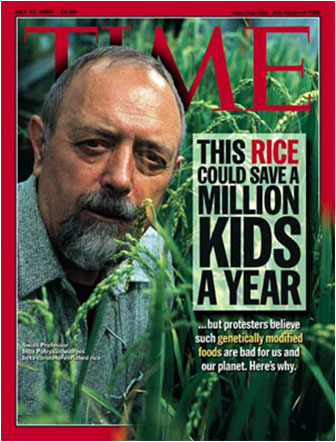
  • child-eyesight-saving “Golden Rice” made the cover of Time (although it still wasn’t working 16 years later)
  • legislative fights erupted over GMO food labels.

All these issues have impacted public opinion and we are still bickering over them.

We don’t know what direction the gene-editing debates will take.[2]  But one crucial battle is already being quietly waged over a question that grows directly out of the GMO battles: do we call gene-edited organisms GMO’s?  This is key not just for the obvious reason that we need some agreement on terms in order to talk with each other; more importantly, it will shape how the public reacts to the new technology.

Is Gene Editing Genetic Modification?

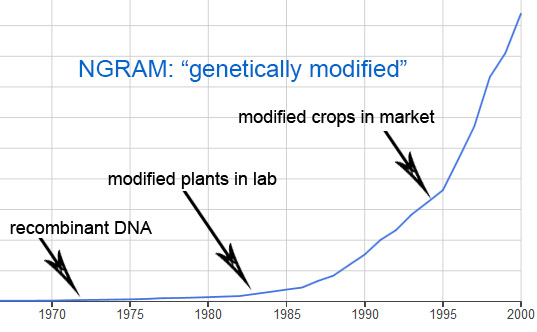
Whether gene editing is genetic modification obviously depends on how you define your terms, and the terms for this stuff have an interesting history.  In 1958, just 5 years after the discovery of the structure of DNA, Nobel laureate Edward Tatum predicted “processes which we might call biological engineering.” ngram-gm When this came along in the early 1970s, it was called “genetic engineering” or “recombinant DNA,” although these terms were mainly used in scientific circles.  Public awareness of the technology rose in the mid-1990s when it appeared in crops and foods; “genetically modified” then came into common use and  “recombinant DNA” declined.

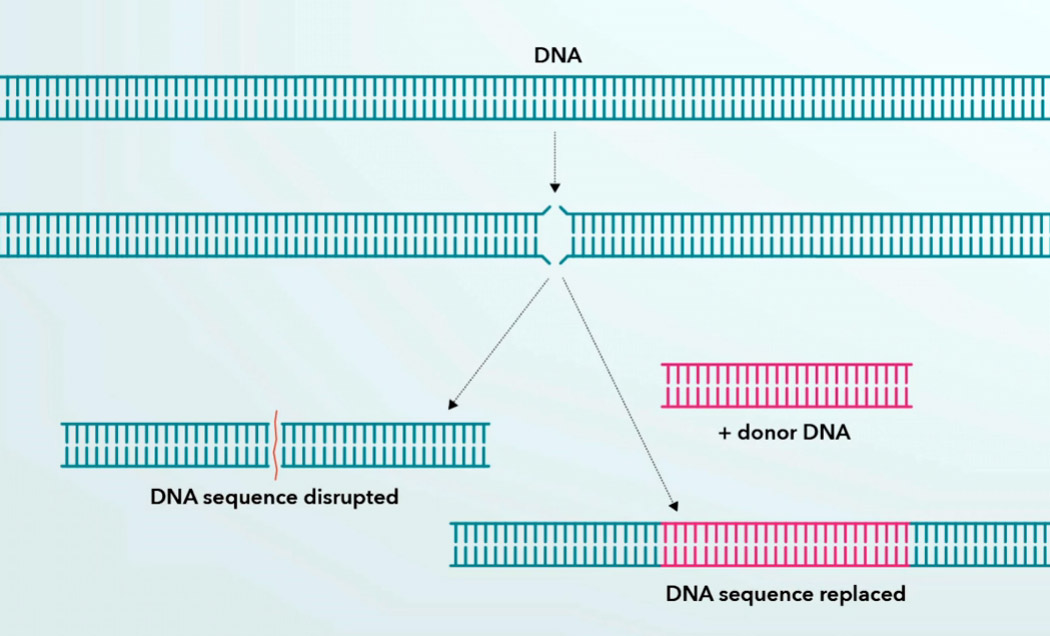
Here’s a short explanation of the science.  Of the technologies involved in genetic engineering, nothing is as important as a group of enzymes called nucleases.  Nucleases exist mainly because a war has been raging between viruses and bacteria for billions of years, and bacteria long ago developed these enzymes to chop up viral DNA.[3]   Biotechnologists learned to manipulate these “molecular scissors” to chop DNA so it could be reassembled and inserted it into target organisms.

crispr

Jennifer Doudna’s figure of DNA sliced by Cas9 and given a piece of donor DNA.  See her Ted talk from 2.55-6.35 for more.

But most nucleases are hard-wired to chop DNA only at specific sequences.  Genome editing uses soft-wired  (programmable) nucleases to cut virtually any DNA in any organism at any specific spot.  (The beauty of CRISPR-Cas9 is that it is easy to program.)  Biotechnologists can then manipulate DNA’s natural repair mechanisms, for instance by adding “donor DNA” that will be patched into the DNA molecule as it self-repairs.

So the older recombinant DNA and the newer gene editing both manipulate bacterial nucleases to change the DNA in target organisms.  But recombinant DNA introduces significant amounts of foreign DNA (1 or more whole genes) while gene editing introduces small amounts of concocted DNA or none at all.

So do you call them by the same name or not?

I said it all depends on how you define your terms, which in turn depends on what you are up to.  And it looks like a priority of gene editors is, to quote New Yorker’s Michael Specter, to “Avoid the Monsanto Problem”.

MonsantoProblem

Ah, the Old “Monsanto Problem”

Just exactly what is the Monsanto problem?  To Specter, it is GMO’s having “failed to engage people,” so people became suspicious and even hostile even “after the technology has been proven both safe and useful.”

An alternative view is that GMO’s have engaged people, but people failed to find them useful. After all, the most common GM crop in the world by far is the Roundup-Ready soybean, which yields a little less and takes a lot more Roundup. And safe? Many of us believed that at least Roundup was safer than many other herbicides, until the FAO concluded that it was likely carcinogenic all along.

But whatever caused the problem, it is a problem, and gene editors understandably want to put as much distance as they can between their new technology and GMO’s.  Which is precisely why a campaign is on over a name.

Examples abound.  Here is a scientist at Cibus Corp (which already has a gene-edited crop on the market) on his company’s own (non-CRISPR) type of gene editing:

A huge technological pivot is going on in crop breeding. If the end of the 20th century was the era of transgenic breeding or GMO technologies, the 21st century is silently turning to non-transgenic breeding or non-GMO technologies.

And we read in Genetic Engineering and Biotechnology News that

The older forms of transgenic genetic modification carry the status of …GMO, a politically controversial label that has hobbled the commercial development of agbio markets…

In contrast, gene editing enables stable and heritable genomic changes quickly and easily without introducing foreign DNA…[whereas] gene editing will enable researchers to modify genetic information in a natural way to bring out of the existing genome entirely new traits. And best of all, regulators have given it the green light to position its products as the non-GMO alternative.

And here’s this from the BioFortified website (reposted on the kennel-barking Genetic Literacy Project website)

GMOs…are transgenic crops, meaning that a gene from a different species has been added to their genome. But in the case of crops modified using CRISPR-Cas9, what’s edited was there to begin with. Technically, nothing has been added from a different species

labbiotech

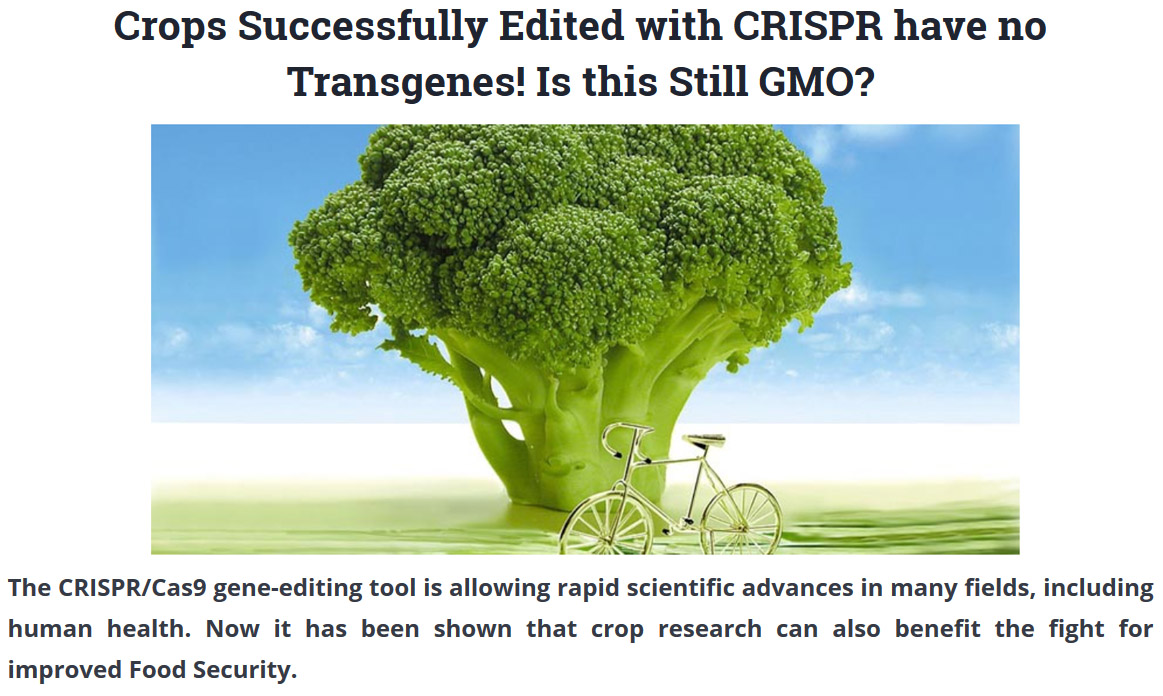
This European Biotech site answers their own question with a resounding NO on the grounds that edited crops lack a transgene.  Why this should be illustrated by a head of broccoli and a bike is opaque to your humble narrator.

(Technically true but it does often have synthesized donor DNA.  But anyway…) let’s continue to the Technology Review where we read that “The appeal is that it offers control over genes without modifying a plant’s genome—that is, without creating a GMO.”

And the European Biotech website answers its own question “Crops Successfully Edited with CRISPR have no Transgenes! Is this Still GMO?” with a resounding NO because gene-edited crops lack transgenes.[4]

Got it?  Gene editing is not genetic modification because it doesn’t introduce foreign DNA.  OK actually it does, but not as much.  And that’s what makes all the difference.  In fact, unlike GMO’s with the transgenes, this is a natural way to introduce traits. Gene edited crops are not GMO’s. Any questions?

I have one. Haven’t biotechnologists been insisting for years that all our food plants are GMO’s?  In fact, that any organism affected by humans is genetically engineered?  That it makes no difference if foreign DNA is involved or not?

I Thought Everything was a GMO, Even with No Foreign DNA

You must have run across the meme that “all our food is genetically modified.”  Biotechnologists seized on this repackaging of the term to counter GMO opponents who were gaining traction with FrankenFood imagery. It has become nearly ubiquitous.

This rather contrived repackaging of the term pushed its way into the pages of Science in a commentary by biotech booster Nina Fedoroff entitled “Prehistoric GM Corn.”  AllCropsAreGMFedoroff was commenting on research on corn domestication that had nothing to do with genetic modification or with her, GMO-splaining that natural mutations were “genetic modifications” and that ancient Mexicans selectively replanting seeds were doing “genetic engineering.”  No foreign DNA or bacterial nucleases were involved and in fact no DNA had been altered — domestication doesn’t alter DNA, just frequencies of naturally occurring genes.  But her point was that if there are any human-induced changes, even just in gene frequencies, then you’ve got yourself a GMO.

If you follow GMO media you see the claim almost every day.  From Fedoroff again and again. From Peter Raven.  In National Geographic.  In the New York Times.  In AgBioWorld. In Business Insider.  In plant science courses.  Journalists have been persuaded that this is a story: “Sorry hipsters, organic kale is genetically modified” explains a Smithsonian headline, taunting a purely imaginary bloc of bearded morons.

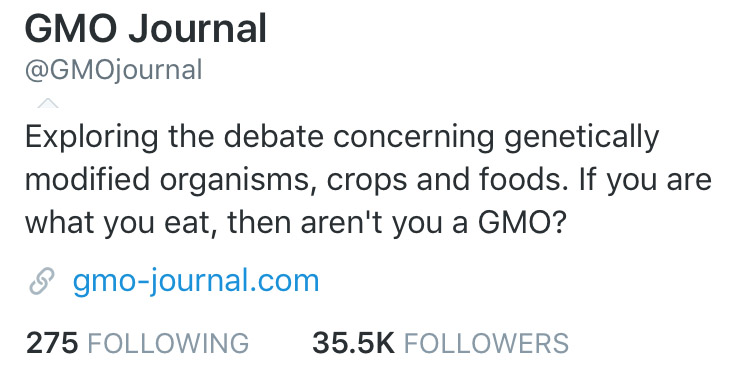
And as long as you’re claiming that all our food is twitter-gmogenetically modified, why not claim that we are too, since we’re eating it? This is exactly what the GMO Journal tweeted today.

Got it? All our food, our own bodies, indeed almost everything in life is genetically modified.

Everything, that is, except for gene-edited organisms, whose DNA has been cleaved by engineered nucleases and has incorporated donated DNA to alter gene function.  That’s just natural.  Don’t call them GMO’s or they will not smell as sweet.

NOTES
[1]. That’s how this controversy was widely understood anyway, although it’s inaccurate.  This famous sterile-seed technology was developed by the USDA and patented with the cotton seed company Delta Pine & Land.  It caught the attention of activists when Monsanto started to buy Delta in 1998, which is when it acquired the nickname “Terminator.”  While the 1998 deal was blocked, Monsanto did later buy Delta although they never commercialized the technology.
[2] Well, we know there will be controversy over the issue of editing human germlines (i.e. making heritable changes).  Chinese scientists have already done this, albeit with non-viable embryos. In her TED talk, Doudna shows a baby edited to prevent disease but also to be a sprinter with perfect pitch and a head of hair. Her only note of caution is that we should “use it wisely” (that’s helpful!). Biologist Robert Pollack points out that “rational eugenics is still eugenics.”
[3] This is obviously a simple explanation omitting much detail.  For instance, these nucleases occur not only in bacteria but in prokaryotes in general, including archaea.
[4]  Does the US government think gene editing is genetic modification? It’s mum on the question; it doesn’t actually regulate GMO’s as GMO’s, instead regulating GM crops as plant pests if they are made with Agrobacterium and regulating then as pesticides if they contain Bt genes. (If they contain neither, they are totally unregulated even if they are genetically modified.)  But countries with GMO-specific regulations are starting to weigh in on the side of NOT calling gene editing a GMO technology.
Posted in Agriculture, Biotechnology, CRISPR | 18 Comments

Golden Rice: Bringing a Superfood Down to Earth

 May 2016: The article “Disembedding grain: Golden Rice, the Green Revolution, and heirloom seeds in the Philippines,” by Dominic Glover and me, has been published in the journal Agriculture & Human Values and is available here. This blog post is based on that article.
February 2016: Also check out the interview on Golden Rice done with Tom Philpott and Raj Patel on their “Secret Ingredient” podcast series.

Few GM crops are discussed as much — and misunderstood as much — as “Golden Rice.”

time-goldenriceGolden Rice is modified to produce beta carotene in the endosperm, rather than only in the bran as in most rice. Beta carotene is a vitamin A precursor, and the hope was that this invention would mitigate Vitamin A Deficiency (VAD), which in extreme cases can cause blindness or death in malnourished children. After appearing on the cover as Time in 2000 as a rice that “could save a million kids a year,” Golden Rice has been a nearly ubiquitous talking point in GMO arguments. As a high-flying GM superfood, it is without peer.

But the battles over Golden Rice have been particularly heated even by the usual standards of GMO bombast. Critics see it as an unproven, expensive, and misguided bandaid—a Trojan Horse to open the floodgates of GM crops into the global south (Brooks 2010:76-83; RAFI 2000). Industry spokesmen, impassioned molecular biologists, and partisan journalists charge that children are being left blind by GMO critics having slowed the rice; hired activist Patrick Moore tirelessly (and cartoonishly) blames Greenpeace — which he claims to have founded — for “murdering” children (AllowGoldenRiceNow.org 2015).

Confusingly, other biotechnologists claim that Golden Rice is already in use and that it has “helped save many, many lives and improved the quality of life of those who eat it” (Krock 2009; also see Thomson 2002:1). These claims cause considerable discomfort to the scientists who are actually doing the Golden Rice breeding (Dubock 2014:73).

All the shouting tends to cover up a crucial issue with Golden Rice: who is it for, exactly?  Proponents usually discuss it as a vitamin tablet headed for generic underfed children in “poor countries” (Beachy 2003), or “developing countries” (Enserink 2008), or occasionally “Asia” (Dawe and Unnevehr 2007).

But here’s the problem.  Golden Rice is not just a vitamin tablet headed for malnourished kids wherever they may be.  It’s not a tablet at all; it’s rice, the most widely consumed and arguably the most culturally freighted crop in the world (e.g., Ohnuki-Tierney 1993). And it is headed specifically for the Philippines.  Golden Rice got its start in the Philippines (Enserink 2008), and it’s being bred and tested in a research institution in the Philippines, to be approved by the Philippine Bureau of Plant Industry, to be sold in Philippine markets to Philippine growers and potentially fed to Filipino children.   (Breeders and researchers in Vietnam, India, and Bangladesh are also working with Golden Rice, but release is unlikely to occur any time soon in those countries.)  Most discussions of Golden Rice ignore this Philippine context. Even economic analyses purporting to calculate “The Cost of Delaying Approval of Golden Rice” (Wesseler, et al. 2014) make no mention of the Philippines.

The neglect of this Philippine context is remarkable because the Philippines is hardly just a country with vitamin A-deficient children (in fact, such children are increasingly scarce there). The country is unique with respect to rice, with a storied history, complicated present, and contested future for the crop. This is the country that brought us the rice half of the Green Revolution (the wheat half was developed in Mexico); the country with famous Picture1rice terraces; the country with a resurgent trade in “heirloom” landrace rice; the country with the famous International Rice Research Institute (IRRI).

And Golden Rice simply doesn’t grow well in the Philippines — not yet anyway, after years of trying.  The actual rice grains on the cover of Time were not adapted to grow where underfed kids live; they were more like the plant equivalent of lab rats.  For the high-flying rice to actually be farmed, it had to be brought down to the ground—literally. It had to be re-bred to grow in a country where it might have an impact.  The Philippines—with the world’s premier rice research station, with a full-fledged biosafety regulatory apparatus, and a high incidence of childhood VAD at the time—was the obvious choice.

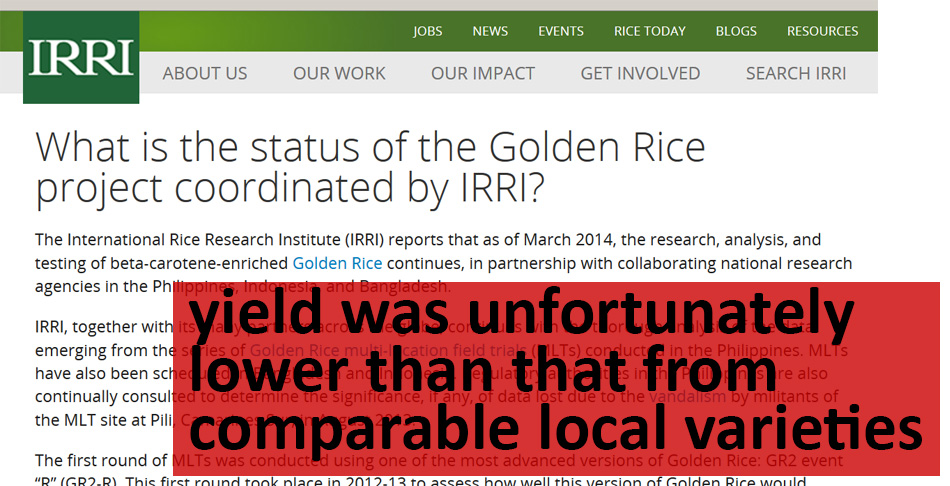
Golden Rice seeds arrived at IRRI in 2001 and began the long process of being crossed into locally-adapted varieties. By 2008, IRRI (along with the Philippine Rice Inst.) was running confined field trials of two different versions of Golden Rice bred into four rice varieties. During 2011-2013, they focused on field trials of Golden Rice bred into the Green Revolution workhorse rice called IR64 and also a popular variety called “Peñaranda” (A. Alfonso, pers comm). But as of this writing, over 14 years after IRRI began trying to bring Golden Rice down to earth in the Philippines, the best varieties still exhibit a “yield drag”—i.e., lower productivity than seeds that are identical except for the Golden Rice trait (Dubock 2014; Eisenstein 2014; IRRI 2014).

That’s right: contrary to claims that millions of children are dying because of Greenpeace’s opposition, Untitled-1Golden Rice is simply not ready, and hasn’t even been submitted to regulatory authorities for approval. IRRI is quite clear about this, as a visit to their website will show. I was at IRRI last month and the word was that 3-5 more years of breeding would probably be needed.

November 2015 addition: The IRRI post cited above (“What is the status of the Golden Rice project coordinated by IRRI?”) was changed after this blog was posted.  Here is the IRRI post from before my blog, and here is the IRRI post as of 10 Nov 2015.

Even if Golden Rice is brought up to speed agronomically, and even if it is approved, released, and adopted by farmers, its goal of saving millions of lives—or even having any significant public health impact—is probably unlikely. Nutrition programs have brought the incidence of childhood VAD from a peak of 40% in 2003 to 15% in 2008 (Food & Nutrition Research Inst. nd), and the incidence has almost certainly fallen more since then. Again, IRRI itself has been transparent, acknowledging on their website that VAD is being effectively reduced without Golden Rice (IRRI nd).

IRRI is also quite explicit that it will release Golden Rice only IF “it is found to be safe” and IF it is “shown to improve vitamin A status” (see their website).  It is not yet known if it will be effective in raising Vitamin A levels in underfed children.  Filipino children who still suffer from VAD have poor diets lacking in the fats that are needed to absorb Vitamin A (Dawe, et al. 2002; Haskell 2012; Nestle 2001). To date, the human feeding trials have only been conducted with well-nourished individuals. In the heavily cited (and since retracted) study by Tang, et al. (2012), children were fed balanced meals with 20% energy from fat; this  demonstrated only that Golden Rice worked in children who did not need it.

Golden Rice has soared as a high-flying superfood on magazine covers, the New York Times, industry front group websites and speeches by paid activists; the problem comes from bringing it down to earth.


Sources Cited

  • AllowGoldenRiceNow.org 2015 About. http://www.allowgoldenricenow.org/about.
  • Beachy, Roger N. 2003 Editorial: IP Policies and Serving the Public. Science 299(5606):473.
  • Brooks, Sally 2010 Rice Biofortification: Lessons for Global Science and Development. London: Earthscan.
  • Dawe, D., R. Robertson, and L. Unnevehr 2002 Golden rice: what role could it play in alleviation of vitamin A deficiency? Food Policy 27(5–6):541-560.
  • Dawe, David, and Laurian Unnevehr 2007 Crop case study: GMO Golden Rice in Asia with enhanced Vitamin A benefits for consumers. AgBioForum 10(3):154-160.
  • Dubock, Adrian 2014 The present status of Golden Rice. Journal of Huazhong Agricultural University 33(6):69-84.
  • Eisenstein, Michael 2014 Biotechnology: Against the grain. Nature 514(7524):S55-S57.
  • Enserink, Martin 2008 Tough lessons from golden rice. Science 320(5875):468-471.
  • Food & Nutrition Research Inst. nd Seventh National Nutrition Survey 2008-2009: Department of Science and Technology (Philippines).
  • Haskell, Marjorie J 2012 The challenge to reach nutritional adequacy for vitamin A: β-carotene bioavailability and conversion—evidence in humans. The American Journal of Clinical Nutrition 96(5):1193S-1203S.
  • IRRI 2014 What is the status of the Golden Rice project coordinated by IRRI? http://irri.org/golden-rice/faqs/what-is-the-status-of-the-golden-rice-project-coordinated-by-irri.  Downloaded 24 Feb 2015.
  • IRRI nd Why is Golden Rice needed in the Philippines since vitamin A deficiency is already decreasing? In IRRI website, http://irri.org/golden-rice/faqs/why-is-golden-rice-needed-in-the-philippines-since-vitamin-a-deficiency-is-already-decreasing.
  • Krock, Becca 2009 Researchers look to enriched crops to solve childhood malnutrition. Student Life, 28 Sept.
  • Nestle, Marion 2001 Genetically Engineered “Golden” Rice Unlikely to Overcome Vitamin A Deficiency. Journal of the American Dietetic Association 101(3):289-290.
  • Ohnuki-Tierney, Emiko 1993 Rice as self: Japanese identities through time. Princeton, NJ: Princeton Univ Press.
  • RAFI 2000 Golden Rice and Trojan Trade Reps: A Case Study in the Public Sector’s Mismanagement of Intellectual Property. RAFI Communique 66.
  • Tang, Guangwen, et al. 2012 b-Carotene in Golden Rice is as good as b-carotene in oil at providing vitamin A to children. American Journal of Clinical Nutrition 96:658–64 [Retracted, August 2015].
  • Thomson, Jennifer A. 2002 Genes for Africa: genetically modified crops in the developing world. Landsdowne: UCT Press.
  • Wesseler, Justus, Scott Kaplan, and David Zilberman 2014 The Cost of Delaying Approval of Golden Rice. Agricultural and Resource Economics Update, Vol. 17, No. 3, Jan/Feb, 2014 17(3):1-3.

Posted in Agriculture, Biotechnology, Food, Philippines | 40 Comments

Unload DDT

What a bloodbath on Wall St — XOM down 5%, UNH down 5%, DIS down 4%.  But the biggest loser this week was DDT.

DDT featured prominently in the recent blog highlighting the ongoing studies by Berkeley’s Barbara Cohn.  Despite “wild rhetoric of the environmentalists” (as Norman “Green Revolution” Borlaug put it in 1971), study after study exonerated DDT, culminating in the famous large-scale Long Island Study.  In many publications in the scientific literature and the popular press, the Long Island Study repeatedly gave DDT a clean bill of health.

At least until epidemiologists found a way to compare breast cancer rates to childhood exposure.

I got email from indignant DDT defenders.  But my point was not so much about DDT (or GMO’s) per se as it was about how hard it is for science to discern long-delayed, distant, and indirect effects on ecosystems and human health.  The Long Island Study’s exoneration of DDT didn’t mean much because it was looking at the wrong questions.

But in a study just out in the International Journal of Cancer, we now learn that the Long Island Study didn’t exonerate DDT anyway.  ParadaEnough time has now passed to allow researchers to now find that levels of blood DDT (or its metabolite DDE) at time of diagnosis partly predicts survival.  High levels are correlated with mortality rates, low levels are inversely correlated.

As Parada et al. point out,

This is the first population-based study in the United States to show that DDT may adversely impact survival following breast cancer diagnosis.

And then this dry academic sentence that is actually quite alarming:

Further studies are warranted given the high breast cancer burden and the ubiquity of these chemicals.

DDT.  Just a few years ago it was a martyr to ignorant anti-chemical luddites perpetrating a “deadly fantasy” about a modern agricultural technology proven safe by science.  Now it not only causes breast cancer in women decades after childhood exposure, but the amount of it in their blood as adults is linked to how long they survive.  And this last finding comes from the same study that previously was “very very conclusive” in showing DDT to be safe.

Sell.

Posted in Agriculture, Industrial Agriculture, Public Health | 8 Comments

GM Foods: A Moment of Honesty

As the latest controversy over GMO’s unfolds – this time it’s about a House Bill that would ban labeling laws – it’s time for a moment of honesty about science and safety. Of course safety is hardly the only bone of contention in GMO debates, but safety is the issue that’s most hotly contested and that’s most central to the labeling bill.

Rep. Mike Pompeo, the sponsor of the bill, writes that activists are misleading consumers with false claims about unsafe food.  Actually, “more than 100 research projects over 25 years” have “affirmed and reaffirmed the safety” of GM foods.

I must point out to my GMO-doubting friends that Pompeo’s statement about the research is accurate. A lot of studies have failed to find any health risk for any GM food. Bizillions of meals with ingredients from GM crops have been eaten with no direct linkage to health problems.  So for those of us who study GM crops professionally, there eventually comes a point to set aside allegiances and emotions and take a frank and careful look at the science.

I have reached that point, but I know of someone else who reached a similar point, someone who was ideally positioned to speak on issues of technology and food and safety. The late Dr. Norman Borlaug, “Father of the Green Revolution” and Nobel laureate, was a passionate proponent of GM crops. This humanitarian scientist captured something important about modern agriculture and how to deal with its critics. Borlaug realized that when lives were at stake, it is appropriate to be impatient, even downright irate, with anti-science critics of valuable technologies.

How to Deal with Anti-Science Fear Mongers

Borlaug made the case against anti-science fear mongers most memorably in a blunt speech to the Food and Agriculture Organization that was later reprinted in the New York Times.[1] From the start it was clear that the time for kid gloves was over. The “vicious, hysterical propaganda campaign,” he began, “by fear provoking, irresponsible environmentalists,” was a detriment to world society. “Vitriolic” attacks against the technology were “distorted” and “one-sided”, making no mention of the technology’s importance in “protecting our food and fiber production.”

These critics are actually few in number, but “extremely effective force in lobbying for legislation” and “brainwashing the general public” with “scare tactics…based on bits of unsubstantiated scientific data, questionable ethics, emotion and oratory.”

Then he came to safety. Despite claims that the technology is dangerous, the Surgeon General is clear that no available information supports this. The safety record of the technology is “truly remarkable,” given the “prolonged exposure by hundreds of millions of people.

Despite the wild rhetoric of the environmentalists about…damage to both human and wild life,” he continued, “as more and more scientific evidence accumulates, the charges … become less and less convincing.” The technology is not “causing any discernable injury to man.”

OK let me come clean.  While it is true that late in life Borlaug was a combative defender of GM crops, this speech was actually delivered in 1971. The agricultural technology he was defending was not genetic modification of crops, which would not appear for over a decade. It was DDT. And as rash as Borlaug’s claims may sound today, they were accurate: hundreds of millions of people had been exposed to DDT, and no injury to human health had been discerned — and wouldn’t be for 36 more years.  The real lesson here is not how to be irate with science’s critics, but how to be humble about science’s weaknesses.

A Long Record of Safety

DDT came into civilian use in 1945. In the 1950s it was used heavily for mosquito control and heavier still in agriculture – particularly in the US, where increasingly fertilized and irrigated grain fields led to a boom in agricultural insect pests.

snorting

Snorting a few lines of nice safe DDT.

Many scientists were sure it was safe from the beginning. Entomologist Kenneth Mellanby reported that when lecturing about DDT in the years after World War II, he “frequently consumed a substantial pinch of DDT, to the consternation of the audience, but with no apparent harm to myself, either then or during the next 40 years.” Entomology professor Gordon Edwards would eat a teaspoon of DDT each week, supposedly “proving” it safe.[2] Early evidence indicated it was harmful to birds but not humans. By 1962, even Rachel Carson’s Silent Spring could cite no solid evidence of impacts on human health.

Still, the US banned DDT in 1972, to Borlaug’s dismay. It remained in the environment, but as more scientific evidence accumulated in the following years, claims of human health impacts continued to be “less and less convincing.” In 1979, the World Health Organization reported that “the safety record of DDT is phenomenally good.” In 1991, agricultural ecologist Gordon Conway and sustainable agriculture expert Jules Pretty published Unwelcome Harvest, an exhaustively-research book on agriculture and pollution.[3] Their conclusion: DDT can severely affect birds, “Yet in humans there is little evidence of a hazard to health, except at very high dosages.”  But DDT proponents even dismissed claims that birds were being affected.

Many became convinced that environmental DDT was contributing to the rising rates of breast cancer, but over 30 separate studies failed to find a link between breast cancer and bodily levels of DDT (or its metabolite DDE).[4] Breast cancer activists and environmentalists lobbied congress to fund research on cancer hotspot areas in the 1990s. This led to the large-scale Long Island Study, focused on breast cancer where pesticides had been used heavily in the past. But in 2002 when results began to appear, the findings again seemed to exonerate DDT.

Many saw this as the end of the road for DDT critics. New York Times reporter Gina Kolata pointed out the lack of conclusive evidence of environmental causes of cancer.[5] She quoted the Long Island Study leader who said the data were “very, very conclusive”: the chemicals they studied “are not associated with breast cancer.”conclusive A large-scale meta-analysis of DDT (and PCB) studies around the same time also failed to find a link with breast cancer. “I think we have the answers” said the head of the meta-study. Anyway, if “the risks are very small and exposures took place in the distant past,” then “it may be beyond the capacity of science to find it.” Although breast cancer activists rejected the Long Island findings, Kolata wrote that “others said it may be time to close the books.”

Looking in All the Wrong Places

The problem with all this is that if you’re looking in the wrong place, it doesn’t really matter how many times or how carefully you look. Environmental factors in breast cancer risk turn out to be strongly age-related. Studies of radiation exposure show that the breast is most likely to develop cancer if exposed in utero, before menarche, and before first pregnancy – but not later. None of the studies of DDT and breast cancer – including the Long Island study that supposedly “closed the book” – measured exposure during these critical windows of breast development.

Come to think of it, how could you even do such research? DDT has been banned for decades. How could you compare incidence of breast cancer – which usually strikes women in adulthood – with DDT exposure early in life? Sounds like something “beyond the capacity of science.”

It isn’t. In a path-breaking study published in 2007,[6] epidemiologist Barbara Cohn of UC-Berkeley’s Public Health Institute used a remarkable dataset on over 20,000 pregnant women and children in Oakland collected in 1959-1967. These were peak years for DDT use in the US. For each individual they knew the age when the spraying started, and they also measured the levels of DDT and DDE in the blood. Then they tracked down the women’s medical records nearly 40 years later. If you are a woman, or if you know any women, you need to know the results.

breastcancer

In the US, 1 in 8 women will develop breast cancer. More stats here. (Men get breast cancer too, but on a much smaller scale.)  There is no single cause; DDT is only one contributing factor.

It turned out that women born before 1931, who were almost all past puberty when the spraying started, were no more likely to develop breast cancer than the control cases. That was generally consistent with the dozens of earlier studies. But women who had the highest exposure to DDT before the age of 14 were five times as likely to develop breast cancer later in life. All the other studies had missed this critical period.[7]

This was only the beginning. Cohn’s team has now completed a 54-year follow-up on daughters born to women in the Oakland study: daughters whose mothers had high levels of DDT while pregnant were more likely to develop breast cancer.[8] Another study found that boys whose pregnant mothers had high levels of DDT were also more likely to develop testicular cancer.[9] Ongoing research is investigating a range of other health impacts.

Even now, no one understands the mechanisms behind the carcinogenic effects. DDT is known to disrupt endocrine systems; the cancer-causing mechanism may specifically have to do with estrogen. Hopefully this research will stimulate experiments to isolate the mechanisms involved.

But what we do know is that it took us 62 years to even begin to “discern the injury” to humans caused by DDT. With one in eight American women today developing breast cancer, Dr. Borlaug’s scathing denunciation of anti-science fear mongers now seems particularly reckless and scientifically naïve.

DDTspraying

There are lots of wonderful images and videos of gleeful kids being directly sprayed with DDT. But the vast majority of DDT was used for overproducing grains, not controlling mosquitoes. Much of it ended up in the water or in the food chain.

But Aren’t GM Crops Different?

Are there lessons here for debates on genetic modification? GM crops are not DDT. But frankly, most of the differences between GM crops and DDT should only heighten our concern. Consider these three differences:

1. DDT is one chemical; GM crops are all different. Crop plants are different and the gene constructs biotechnologists paste together are different; moreover each “transformation event” (meaning when the gene construct is inserted into one of the target plant’s chromosomes) is unique. Each transformation event raises a host of questions, only some of which have to be answered before a plant is released (more on this...). This is why the World Health Organization says

Different GM organisms include different genes inserted in different ways. This means that individual GM foods and their safety should be assessed on a case-by-case basis and that it is not possible to make general statements on the safety of all GM foods.

It’s also why one of the corporate scientists in charge of the safety assessment of the world’s first GM food (Calgene’s Flavr-Savr tomato) writes about the “absurdity of claiming that all GMO’s are safe.”

2. Health impacts for GM crops will be even harder – actually much harder – to detect than for DDT. DDT is measurable in the blood; some effects of highly processed ingredients made from GM plants may be “beyond the capacity of science to find.”

3. Many more “non-industry” scientists have a professional and personal (and sometimes financial) stake in GMO’s than they did in DDT. Borlaug was not financially dependent on the pesticide industry (although he did appear at press conferences organized by DDT manufacturers[10]); however academic research on GM plants is routinely funded by the biotech industry, and researchers are beholden to biotech corporations for access to patented genes. Academic biotechnologists (along with a small pack of journalistic attack dogs, mostly funded by the industry) swarm on anyone – including scientists – who point to uncertainties about GM crops. They often evince the same scorn that Borlaug showed towards the “hysterical propaganda” on DDT. In fact the words are almost identical.

Billions of people have eaten genetically modified food over the past two decades. Not one problem has been found…

And the “The Debate About GMO Safety Is Over“…

A frank look at the science points us in the opposite direction.  The billions of meals with traces of one or another GM ingredient means even less than the exposure of hundreds of millions to DDT.  The claim that any GM crop is known to be safe … let alone all GM cropslet alone all future GM crops — is reckless, foolish, and scientifically silly. And if Congress actually uses this as a justification for a bill prohibiting state labeling laws, then it has reached a new low.

References

1. Delivered as the McDougall Memorial Lecture at the FAO Conference, 8 Nov 1971.  Later excerpted in Borlaug, N.E., Mankind and Civilization at Another Crossroad: In Balance with Nature – A Biological Myth. BioScience, 1972. 22(1): p. 41-44.   Borlaug, N.E., DDT, the First Domino, in New York Times. 1971. p. 13.
2. Wurster, C. 2015 DDT Wars: Rescuing Our National Bird, Preventing Cancer, and Creating the Environmental Defense Fund. New York: Oxford Univ. Press, p. 154.
3. Conway, G. and J. Pretty, Unwelcome harvest: agriculture and pollution. 1991, London: Earthscan.
4. Cohn, B.A., Developmental and Environmental Origins of Breast Cancer DDT as a Case Study. Reproductive Toxicology (Elmsford, N.y.), 2011. 31(3): p. 302-311.
5. Kolata, G., What Causes Cancer: Can Science Find the Missing Link?, in New York Times. 2002: New York, N.Y. p. 2-c1.
6. Cohn, B.A., et al., DDT and Breast Cancer in Young Women: New Data on the Significance of Age at Exposure. Environ Health Perspectives, 2007. 15(10): p. 1406–1414.
7. Eskenazi, B., et al., The Pine River Statement: Human Health Consequences of DDT Use. Environmental Health Perspectives, 2009. 117(9): p. 1359-1367.
8. Cohn, B.A., et al., DDT Exposure in Utero and Breast Cancer. The Journal of Clinical Endocrinology & Metabolism, 2015.  Online (in press) jc.2015-1841.
9. Cohn, B.A., P.M. Cirillo, and R.E. Christianson, Prenatal DDT Exposure and Testicular Cancer: A Nested Case-Control Study. Archives of Environmental & Occupational Health, 2010. 65(3): p. 127-134.
10. Cullather, N., The hungry world: America’s cold war battle against poverty in Asia. 2010, Cambridge MA: Harvard Univ. Press, p. 247.
Posted in Agriculture, Biotechnology, Food, Public Health, Regulation | Tagged , , , | 57 Comments

Three stories on the factory farm

Three items crossed my desk this week concerning the factory farm scene, i.e. CAFO’s or Confined Animal Feeding Operations.  Two were scientific studies with troubling implications for our health, and one was a dumb piece of clickbait concerning bestiality. Guess which got the press attention.

First the two important ones, both pertaining to, well, shit.

raining

“It’s like it’s raining!” Except for one difference: it’s shit.

We all know that “shit happens,” but what many people don’t know is how much shit happens to come from factory farms. Some is picked up by the wind; some is sprayed out of giant nozzles.  “It’s like it’s raining!” says a neighbor in this video… if you’re in a hurry, go to 2.30.  (And sometimes it happens to explode but that’s another story.)

All the particulate matter emanating from CAFO’s is clearly a problem.  But now scientists have started looking into just what’s in all this migratory manure.  And it’s starting to look like the shit itself is not the biggest worry; it’s what IN the shit.


Like genes for antibiotic resistance.

The rise of antibiotic resistant bacterial diseases is one of our most frightening public health problems.  This is a medical nightmare with multiple causes, but nontherapeuric antibiotics used just promote growth is emerging as a leading cause.  It is also poorly understood: as the authors of a recent review in the microbiology literature put it, efforts to model the impact of nontherapeutic antimicrobials “are thwarted by deficits in key knowledge of microbial and antibiotic loads at each stage of the transmission chain.”

This recent article in Environmental Health Perspectives reports on a study designed to fill in one of those key knowledge gaps: Factory Cow.jpg-550x0could CAFO manure in the wind be spreading antibiotic resistance?  Environmental toxicologists analyzed particulate matter downwind from 10 cattle CAFO’s in Texas.  They found what they were afraid they’d find: the airborne manure was laced with not only antibiotics, but genes for antibiotic resistance.

Their samples were collected very close to the CAFO’s, and they did not study how far these contaminants could travel.  But they do cheerfully point out that clouds of dust have been known to travel over 6000 miles, and to carry diseases very long distances.


And like endocrine disrupting chemicals.

endocrine-systemWe have been busy pumping our environment full of endocrine disruptors, mainly through our food & agriculture systems. They turn boy frogs into girls; they make girls menstruate earlier and boys have smaller testicles; they cause a range of diseases including cancers; they help make us obese (see my earlier post on this).   We urgently need to figure out how endocrine disruptors work in the body and how they get into the body.

It turns out that cattle in Texas CAFO’s are not only fed nontherapeutic antibiotics to make them grow faster, but also endocrine-disrupting steroids.  How does this practice affect public health?  This second study of particulate matter blowing from cattle factory farms gives us part of the answer.  The same group of environmental toxicology trouble-makers looked at samples of airborne particulate matter from around Texas CAFO’s, finding evidence of synthetic androgen and estradiol.  This indicates that “steroids affiliated with feedyard PM have the potential to elicit endocrine-modulating effects.”

The press has shown scant interest in these findings, although it wouldn’t take much journalistic ingenuity to create an attention-grabbing story about the cloud of fecal dust laced with antibiotic resistant genes and endocrine disrupting chemicals wafting from factory farms.  They are reserving their attention for more important things…


Which brings us to the third factory farm story for the week, in which a group called Mercy for Animals ran to the press with some reports that factory farm “workers were fondling the genitals of animals” and “making crude sexual remarks” – presumably where the animals could overhear.

Needless to say, this was the story that caught the press’s attention. HuffPostLiveIt was the one that got the HuffPostLive treatment, complete with a sultry news wench interviewing representatives of the Humane Society and Mercy For Animals.

Factory farms are a disgrace, not just for their long list of environmental and public health impacts but for their inexcusable treatment of animals on a massive scale. Life in a CAFO is depicted luridly online and described vividly by Michael Pollan and others.  Life is a contaminated hell, and animals have much bigger things to worry about than the occasional handjob from a worker — if this is even happening at all, which I doubt.

The “crude sexual remarks” – (“crude” being superfluous here, unless you know of some sophisticated sexual comments to be made about confined beasts) – have to be even lower on the worry scale.  Yes, farm animals can learn some vocabulary. Leadbelly was speaking mule when he wrote “Whoa back buck and gee by the lamb.”  Where I work in Andhra Pradesh, the bullocks understand simple Telugu commands like right, left, and stop. But CAFO animals do not understand any of our many terms for genitals. I’m not sure I understand them all myself.

If anyone thinks this is missing the point — that CAFO’s offer a degraded existence for meat animals — then I would say that point is obvious, and is made much more strongly by the many writers and surreptitious videographers who have documented that existence.

We have more serious things to be concerned about than inappropriate touching and talking in the CAFO.  Like the bona fide torture of CAFO animals and the public health debacle in the cloud of their shit.

Posted in Agriculture, Industrial Agriculture, Public Health | Tagged , , , | 5 Comments

Do Farmers Want GM Crops?

Do small farmers in developing countries want GM crops?  That is a truly divisive question, and it seems like anyone with a dog in the hunt gets to speak for the farmers.  I want to consider what’s wrong with the many claims to represent the “farmer’s voice.”

But first, a word about the idea of just using farmer adoption as indicative of what they want.  In India, land of a hundred million farmers, we are told by GM enthusiasts that the country’s only GM crop — Bt cotton — has been the “fastest adopted agricultural technology in history.”  The implication is that Bt cotton must be the most wanted technology (e.g., Herring 2008).

And we are just as regularly told to never second guess the farmer.  As one Monsanto-backed pundit puts it,  “farmers are excellent businessmen who aren’t persuaded by anything or anybody that doesn’t make their job easier or more profitable” (Fumento 2003:277).  nobelTherefore, according to another industry cheerleader, “We should leave the choice of selecting modern agricultural technologies to the wisdom of Indian farmers” (Pinstrup-Anderson & Schioler 2001:108).

But it’s interesting that the same biotechnology interests that now marvel at farmer wisdom and astuteness in dealing with agricultural technologies until recently saw the farmer as an incorrigible slack-jawed nitwit.  Here is Monsanto a few years before Bt cotton was adopted:

Weeds, for instance, are responsible for 30- 60% of the damage to our agriculture yields. But there is very little awareness of this among Indian farmers, while those who are aware, lack knowledge of the appropriate solutions (Monsanto India 2000)

Did you get that?  They not only didn’t know how to get rid of weeds, they didn’t know weeds were lowering their yields.

Here’s more:

ASSYou don’t have to teach these farmers new culture practices…you just give them a seed, and that increases productivity in that seed itself… for years people have tried to change cultural practices of these farmers, and it just hasn’t worked… you have to re-educate them as to how to modify their farming practices themselves. But with biotech, the technology is in a seed. All you have to do is give them the seed (McGlouthlin 2001).

(Give them the seed? I love it.)  So if I’m picking up what they’re putting down, the farmer’s desires are something to be tut-tutted and hopefully corrected… unless he is buying your technology, in which case he is a rocket surgeon, not to be questioned.

Actually technology adoption is much more complicated than farmers simply wanting or not wanting something (for instance, see our recent work on herd dynamics in seed choice).  But still there is a lively trade in constructing claims about what farmers hanker for.  The claims are in peer-reviewed journals, in the media, and in reports and propaganda from pro- and anti-GMO parties.  Like so much in the world of GMO’s, they disagree sharply.  In fact most are somewhere between meaningless and misleading.  If you’re interested in why these claims are generally so flawed, part of our answer appears in “The Problem with the Farmer’s Voice,” an article just published in the journal Agriculture and Human Values.  You can read it here if you want; it’s pretty short.  But then again so is life so let me just give you a summary.WhatYouWant

Claims to represent the “farmer’s voice” generally have two built-in biases.  (The recent article also covers a third bias which I’m leaving out for brevity’s sake.)

First is information bias.   If farmers have never seen or used a technology, then their opinion is basically a result of how you characterize it to them. The people doing the interviews know this, and they’re hoping you don’t think about it.

For instance, in 2001, with possible approval of India’s first GM crop looming, a consortium of anti-GM groups convened a ‘‘citizens jury’’ in Andhra Pradesh.  Aiming to give voice to ‘‘those people most affected’’ by visions of agricultural development, organizers selected a jury with heavy representation of poor farmers (although they are rarely early adopters of technology) and showed videos they themselves had made depicting three visions of the agricultural future.  THE TRUTHAnd guess what: the farmer jurors largely agreed with a statement expressing opposition to GM crops, including vitamin A rice and Bt cotton (Pimbert and Wakeford 2002). A similar farmers jury in Mali in 2006, as that country was considering Bt cotton, had a similar result (Bryant 2007), generating headlines in London ‘‘Mali farmers reject GM crops as attack on their way of life’’ (Selva 2006).

On the other end of the spectrum we have a study by the biotech-booster outfit ISAAA.  They constructed a voice for Philippino ‘‘farmer leaders’’ on Golden Rice by asking if they wanted to grow “a new ‘yellow rice’ that is fortified with vitamin A and that will be given free by the IRRI” to most farmers.  (Actually Golden Rice doesn’t contain vitamin A but a precursor, and IRRI itself has said that it hasn’t yet been established that Golden Rice raises vitamin A levels.)   But readers will be unsurprised that when it was put this way, most respondents answered this characterization of Golden Rice in the affirmative (Chong 2003).

I’m reminded of how Steve Jobs scoffed at focus group testing of the ipad, on the grounds that consumers couldn’t judge a new product with which they were unfamiliar.  But imagine for a minute that there was a focus group and you were running it.  How do you describe the device to the focus group?  An in-between device that’s too big for your pocket but not nearly as powerful as a notebook?  Consumers will say they don’t want it.  A device that has many of the most useful features of both notebooks and smartphones, that fits into a purse or small briefcase but lets you watch movies? They’ll demand it.

The second problem with “farmers’ voice” claims is short term bias.  Adoption of agricultural technologies often leads to unforeseeable latent effects.  They may be indirect, they may be much delayed, and they are sometimes disastrous.  Most farmers voice claims are oddly oblivious to this fact, focusing instead on the present moment.

Here’s an example.  A few years ago, as concern was rising about the spread of Roundup-resistant weeds, science journalist Dan Charles rang up Monsanto to ask why they didn’t know this would happen.  They said they “had just spent more than a decade, and many millions of dollars, trying to create the Roundup-resistant plants that they desperately wanted — soybeans and cotton and corn.”

palmer

This Palmer Amaranth’s parent is bursting with pride.

I’m trying to imagine the farmers voicing this desperate want.  “Oh please, give us a seed-herbicide combo that will make weed management easier at first but within a few years will leave us with herbicide-resistant weeds so big we have to use a chainsaw.

India is another example of how the impacts of technology can change dramatically after they are adopted by farmers.  We’ve already noted that widespread adoption of Bt cotton (mainly between 2005-8).  This was interpreted as the clear sound of the farmers voice, sounding like the most resounding yes since the last page of Ulysses. Then for icing on the cake was a swarm of studies claiming to have isolated significant yield advantages in the first year or two or even before adoption, validating the dogma of never questioning farmer wisdom.  (A summary of these studies is here, including mentions of the rare exceptions to the obsession with short-term results.)

Bt cotton enthusiasts may see this as an open and shut case of giving the farmers what they want but it’s also a case of fetishizing of short-term yield boosts and ignoring the bigger picture and longer term. Here’s why: the whole reason the farmers said yes to Bt cotton in the 2000s was the catastrophic agroecological fallout from their yes to the last round of farm technologies. Pesticide-intensive proprietary hybrid cotton seeds spread in the 1990s (details here).  But quick profits (due mostly to favorable markets and initial effectiveness of pesticides) rapidly gave way to pesticide treadmills, spiraling input costs, debt and despair. It was this package that formed the technological component of the tragic problem of farmer suicide

The hybrid seeds would also have problematic long-term effects. They led to farmers being inundated with hundreds of often deceptively labeled brands which helped to undermine the skilling process (details here).

What farmers said yes to was what was before their eyes, not to what lay down the road. All of this fell outside of the decision-making window of farmers and of the analysis window of researchers. If you ask a farmer whether he would buy a certain technology, or if you assume that a purchase is a straightforward indicator of farmer desire, then you will convince yourself that the farmer’s voice is calling out for that technology.  But in this case, a better question to ask would have been if the farmers wanted a seed/pesticide technological regime that would lead them into an unsustainable, suicidal, agro-entomological hell.¹

NOTES
1.  Does all this mean there is no value in any research on farmer wants regarding GM crops?  No, in fact there is a study in the same issue of Agriculture and Human Values that tackles the topic more thoughtfully.  Even its title –“No one asks for a meal they’ve never eaten, or do African farmers want genetically modified crops?” — recognizes the limitations of such studies.   This study by Schnurr and Mujabi-Mujuzi draws on some other work by Cleveland, Soleri and others that approaches the question in a more fruitful way; see references below.
REFERENCES
Bryant, P. (2007). Mali’s Farmers’ Jury: an attempt to democratise policy-making on biotechnology. Biotechnology Policy in Africa. N. G. Clark, J. Mugabe and J. Smith. Nairobi, African Centre of Technology Studies.
Charles, D. (2012). “Why Monsanto Thought Weeds Would Never Defeat Roundup.” The Salt.
 Chong, M. (2003). ” Acceptance of golden rice in the Philippine ‘rice bowl’.” Nature Biotechnology 21(9): 1.
 Cleveland, D. A. and D. Soleri (2005). “Rethinking the risk management process for genetically engineered crop varieties in small-scale, traditionally based agriculture. Ecology and Society 10 (1): 9. [online]
 Fumento, M. (2003). BioEvolution: How Biotechnology is Changing Our World. San Francisco, Encounter Books.
 Herring, R J. 2008. Bt cotton: Why do so many smart people get it so wrong? The Hindu, 28 Aug. Hyderabad.
 McGlouthlin, M. (2000). “Interview.” Harvest of Fear. PBS Nova.
Monsanto India (2000). Investors Annual Report.
Pimbert, M. P. and T. Wakeford (2002). Prajateerpu: A Citizens Jury / Scenario Workshop on Food and Farming Futures for Andhra Pradesh, India. London and Sussex, IIED and IDS.
Pinstrup-Andersen, P. and E. Schioler (2001). Seeds of Contention: World Hunger and the Global Controversy over GM Crops. Baltimore, Johns Hopkins Univ. Press for the International Food Policy Research Institute.
Schnurr, M. and S. Mujabi-Mujuzi (2014). ““No one asks for a meal they’ve never eaten.” Or, do African farmers want genetically modified crops?” Agriculture and Human Values 31(4): 643-648.
Selva, M. (2006). Mali farmers reject GM crops as attack on their way of life. The Independent 31 Jan. London.
Soleri, D., et al. (2008). “Testing assumptions underlying economic research on transgenic food crops for Third World farmers: Evidence from Cuba, Guatemala and Mexico.” Ecological Economics 67: 667–682.
Stone, G. D. and A. Flachs (2014). “The problem with the farmer’s voice.” Agriculture and Human Values 31(4): 649-653. (pdf)
Stone, G. D., et al. (2014). “Rhythms of the herd: Long term dynamics in seed choice by Indian farmers.” Technology in Society 36: 26-38. (pdf)
Stone, G. D. (2012). “Constructing Facts: Bt Cotton Narratives in India.” Economic and Political Weekly 47(38): 62-70. (pdf)
Stone, G. D. (2011). “Field versus Farm in Warangal: Bt Cotton, Higher Yields, and Larger Questions.” World Development 39(3): 387-398. (pdf)
Stone, G. D. (2007). “Agricultural Deskilling and the Spread of Genetically Modified Cotton in Warangal.” Current Anthropology 48: 67-103. (pdf)
Posted in Agriculture, Biotechnology, India | 14 Comments